Italian Schengen Visa Photo Requirements 2026
Italy is a member of the Schengen Area, and all Italian visa photo requirements are governed by the EU Visa Code (Regulation EC 810/2009) alongside ICAO Doc 9303 biometric standards. These rules apply to every Italian short-stay Schengen visa (Type C) and long-stay national visa (Type D) application, whether submitted at an Italian Consulate, a VFS Global visa application centre, or via the Italian online pre-application portal. As confirmed on the official Italian Consulate General website (esteri.it), the photo for a Schengen visa application must be a recent passport-style photograph measuring 3.5 cm × 4.5 cm with a white background and full front view. Non-compliant photos are rejected without exception at the application stage.
Official Photo Dimensions and Technical Specifications
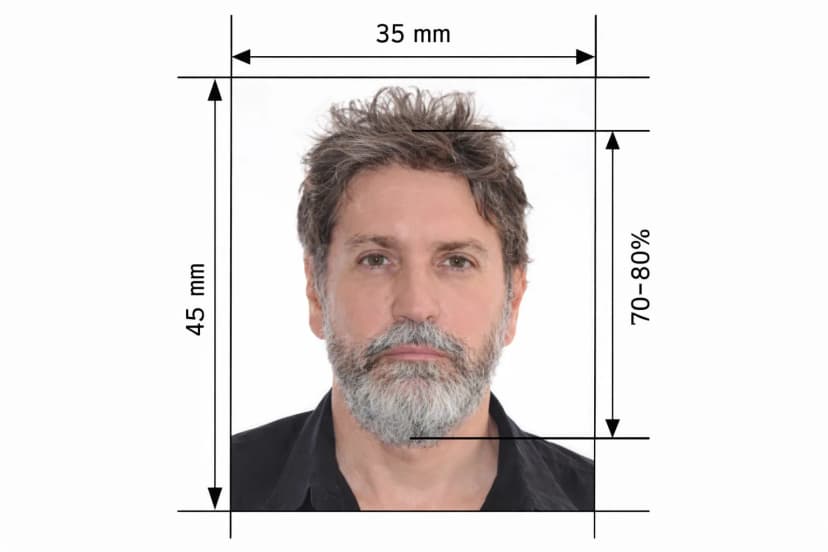
The required photo size for an Italian Schengen visa is 35 mm wide by 45 mm tall — the universal Schengen format. The face, measured from the bottom of the chin to the top of the crown, must be between 32 mm and 36 mm, placing it within the 70 to 80 percent biometric zone of the photo height. This is the same specification used across all 29 Schengen member states and is non-negotiable. The US 2×2 inch format is a different shape and size, and will not be accepted at Italian consulates. For in-person applications, the photo must be printed in full colour on high-quality photographic paper. For online submissions, the file must be in JPEG format; most Italian consular portals specify a minimum resolution of 600 × 750 pixels and a recommended 300 DPI output.
Italian Schengen Visa Photo — Specifications 2026
Background Rules
The Italian Consulate General specifies a white background for Schengen visa photos — this is the officially stated requirement on the esteri.it government portal. White is the universally accepted background colour across all 29 Schengen states and eliminates any risk of rejection on background grounds. Some guidance materials reference light grey as an acceptable alternative for contrast purposes, but white remains the stated standard. The background must be completely uniform — no gradients, shadows, patterns, or visible objects behind the subject are permitted. A shadow falling behind the head from poor lighting is one of the most frequent rejection causes and is entirely avoidable with correct positioning and diffused lighting.
Expression, Head Position, and Gaze
All Schengen visa photos must comply with ICAO biometric positioning standards. The face must be fully forward-facing with no tilt or rotation to either side. The expression must be completely neutral with the mouth closed — even a slight smile can be grounds for rejection at Italian consulates, which are among the stricter Schengen posts in Europe. Both eyes must be open, fully visible, and looking directly into the camera. The face must not be obscured by hair, accessories, or shadows. There must be no red-eye effect.
Glasses and Accessories
Sunglasses and tinted lenses are never permitted in Schengen visa photos. Clear prescription glasses are technically not banned under Schengen rules, but Italy allows them only if there is no glare, no shadow, and no heavy frame obscuring the eyes. Given that glare and shadow from glasses are common causes of biometric rejection, removing glasses entirely is the most reliable approach. Hats and head coverings are not permitted except for documented religious or medical reasons, and even then the full face must remain clearly visible.
Clothing and Colour Contrast
Everyday clothing is required — uniforms, costumes, and official-looking attire must not be worn. Avoid white and very light-coloured clothing, as these can blend into the white background and reduce the contrast needed for biometric processing. Dark clothing provides the best contrast against a white background. Jewellery is permitted as long as it does not obstruct any part of the face.
Number of Prints and Submission
For in-person Schengen visa applications at Italian consulates or VFS Global centres, two identical printed photographs from the same session are required. The photos must be printed on professional photographic paper — unmarked on both sides, free of creases, tears, or damage, and unaltered by computer software or filters. Photos from different sessions, even if taken on the same day, are not considered identical and may be rejected.
Visa Information System (VIS) Compliance
Your Schengen visa photo is enrolled into the European Visa Information System (VIS), where it is retained for five years alongside fingerprint biometrics. The VIS runs automated facial recognition checks against each uploaded image, which is why sharpness, correct exposure, and accurate colour rendering are technically essential — not just cosmetic preferences. Blurry, dark, or incorrectly exposed photos fail VIS enrolment and result in application rejection. Our AI tool produces a correctly exposed, sharp JPEG output that passes automated biometric checks.
Photo Recency
The photo must have been taken within the last six months. Italian consulates are noted for being particularly strict on this rule — a photo within the six-month window that no longer reflects the applicant's current appearance (due to changes in hairstyle, colour, or facial hair) may be rejected and a newer photo requested.
Get Your Italian Visa Photo Right — First Time
A rejected Schengen visa photo delays your entire application and can affect your travel dates. Our AI tool produces a biometric-compliant 35×45 mm photo with a white background, correct 32–36 mm face height, and a 300 DPI JPEG — meeting the standards required by the Italian Consulate General (esteri.it) and the EU Visa Code Regulation EC 810/2009 from the very first attempt.
Italian Schengen Visa Photo Checklist 2026
- Size: 35 × 45 mm — US 2×2 inch format is not accepted.
- Face height: 32–36 mm chin to crown; 70–80% of photo height.
- Background: White — uniform, no shadows, no patterns.
- Expression: Fully neutral, mouth closed, no smile.
- Eyes: Both open, no red-eye, looking directly into the camera.
- Head position: Full front, no tilt or rotation.
- Glasses: Remove if possible; sunglasses and tinted lenses always rejected.
- Clothing: Everyday attire, avoid white tops, no uniforms or costumes.
- Print quality: High-quality photographic paper, unaltered, undamaged.
- Colour: Full colour only — black and white rejected.
- Copies: Two identical prints from the same session for in-person applications.
- Recency: Taken within the last 6 months, reflecting current appearance.
- VIS compliance: Photo must pass automated biometric facial recognition checks.