Italian Passport Photo Requirements 2026: The Complete Fototessera Guide
The Italian biometric passport — passaporto elettronico — is issued by the Ministero dell'Interno through the Polizia di Stato and processed at local questure (police headquarters) across Italy. The photo standard used is the European biometric fototessera format, which is also aligned with ICAO Doc 9303 international standards for machine-readable travel documents. In 2026, these requirements remain unchanged in their core specifications and apply equally to passport renewals, first-time applications, and the electronic identity card (Carta d'Identità Elettronica, CIE). Getting your fototessera right before your questura appointment is essential — appointment slots can take months to secure, and a rejected photo means starting the process again.
Official Photo Dimensions and Format
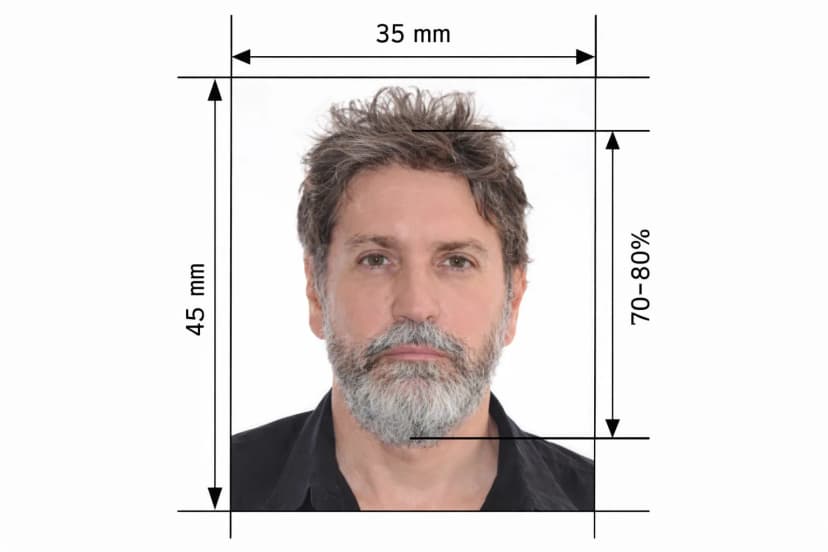
The Italian passport photo must be exactly 35 mm wide by 45 mm tall — the standard European biometric format, often referred to as 3.5 × 4.5 cm or fototessera. This is distinct from the US 2×2 inch format, and submitting the wrong size is one of the most common causes of rejection at the questura. The face, measured from the bottom of the chin to the crown of the head, must fall between 32 mm and 36 mm — covering approximately 70 to 80 percent of the photo height. At 300 DPI, this corresponds to a digital image of 413 × 531 pixels. The file format for digital submissions is JPEG; for digital workflows such as the CIE-Online portal managed by the Ministero dell'Interno, the file must be under 500 KB and at least 552 × 630 pixels.
Italian Passport — Technical Specifications 2026
Background Requirements
The official Italian Consulate General requirement — as stated on the esteri.it government portal — specifies a white background. White is the safest and universally accepted choice across all Italian questure and consulates. Some questure may accept a very light, uniform grey for improved contrast with fair skin, but this is not guaranteed across all offices. Patterned, coloured, or shaded backgrounds — including shadows falling on the background behind the head — will result in rejection. For best results, stand at least one metre in front of a plain white wall and use diffused, even lighting to prevent the shadow behind the head that is the most common cause of background rejection in Italy.
Print Quality and Paper Type
Italian authorities are strict about print quality. The Polizia di Stato requires that photos be printed on high-quality photographic paper — matte or semi-matte finish is standard and preferred; some questure have rejected photos printed on glossy paper when glare affects legibility. The photo must be sharp, correctly exposed, and free of pixelation, blur, or visible inkjet dots. Damaged, creased, folded, or ink-marked photos are rejected. Our digital file is calibrated for 300 DPI professional lab printing, ensuring the final print meets the Polizia di Stato's high standards.
Facial Expression, Head Position, and Gaze
The Italian fototessera requires a neutral expression with the mouth closed. Smiling, frowning, or any exaggerated expression is not permitted, as the ICAO biometric standard requires the face to be in its resting, everyday position for reliable facial recognition. The face must be fully forward-facing — no tilt, no rotation to either side. Both eyes must be open and clearly visible, looking directly into the camera. The face must be fully visible without any part obscured by hair, accessories, or shadows. The photo must accurately reflect your current appearance.
Glasses, Accessories, and Clothing
The Polizia di Stato now actively discourages glasses in passport photos to avoid glare and shadow issues that can cause biometric scanning failures. While this is not an absolute ban, removing glasses is the safest approach. Sunglasses and tinted lenses are never permitted under any circumstance. Hats and head coverings are generally not allowed; exceptions exist for documented religious or medical reasons, in which case the face must still be fully visible and an appropriate supporting statement may be required. Everyday clothing is recommended — avoid white or very light-coloured tops, which can blend into the white background, and avoid uniforms or costumes. Jewellery and facial piercings are permitted as long as they do not obscure any part of the face.
Photo Recency and Current Appearance
The photo must have been taken within the last six months and must accurately reflect your current appearance. Italian consulates are particularly strict about this rule — even if a photo is within the six-month window, a significant change in hairstyle, hair colour, or facial hair may prompt a request for a newer photo to ensure the document accurately identifies the holder.
Children and Infants
The same fototessera specifications apply to children and infants. Only the child should appear in the photo — no parent, carer, or other person may be visible. Baby equipment, toys, and car seats must not appear. For infants who cannot hold their heads independently, laying them on a plain white or off-white surface works well; ensure no shadows fall across the face. Infants' eyes do not need to be fully open, but all other rules apply.
Evita Code e Rifiuti alla Questura
Securing a passport appointment at an Italian questura can take several months in 2026. A rejected photo wastes that appointment entirely. Our AI tool automatically crops your face to the 32–36 mm biometric zone within the 35×45 mm fototessera frame, sets a clean white background, and delivers a 300 DPI JPEG ready for professional printing — meeting the standards of the Polizia di Stato and the Ministero dell'Interno on the first attempt.
Italian Passport Photo Checklist 2026
- Size: 35 × 45 mm (fototessera standard).
- Face height: 32–36 mm chin to crown; 70–80% of photo height.
- Background: Plain white — uniform, no patterns, no shadows.
- Expression: Neutral, mouth closed, eyes open and forward-facing.
- Glasses: Remove if possible; sunglasses and tinted lenses always rejected.
- Head position: Full front view, no tilt or rotation.
- Print quality: Matte or semi-matte photographic paper, 300 DPI — no blurring, pixelation, or damage.
- Colour: Full colour only — black and white rejected.
- Recency: Taken within the last 6 months, reflecting current appearance.
- Digital (CIE portal): JPEG, min 552×630 px, max 500 KB.
- Retouching: No digital alterations, filters, or beauty corrections.