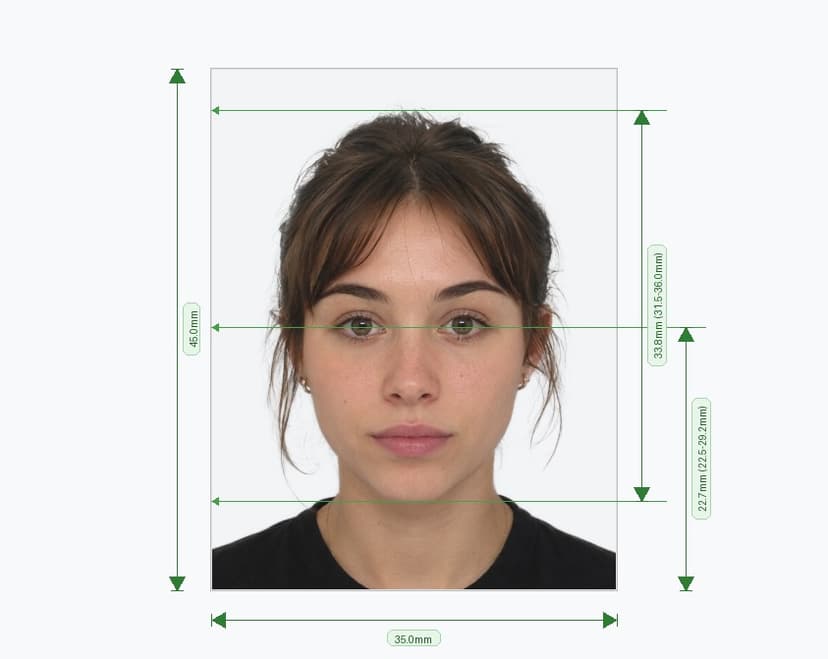
Germany Visa Photo Generator: Biometrisches Visafoto in Seconds
Upload any clear, front-facing photo, and this tool builds a compliant Passfoto Visum Deutschland for the Schengen Visa (Category C) or the National Visa (Category D) — correct 35mm x 45mm size, correct face height, and a verified light background, matching the official Foto-Mustertafel used by every German mission. This is the fastest way to prepare a germany visa photo requirements compliant file without a studio visit.
How This Germany Visa Photo Editor Works
- Step 1 — Upload: Choose a recent front-facing photo, taken within the last 6 months.
- Step 2 — Auto-crop and correct: The tool sets your face height to 32mm-36mm, centers the eyeline, and applies a uniform, contrast-checked light background.
- Step 3 — Download: Get a print-ready 35mm x 45mm photo for your printed VIDEX application, plus a digital JPEG at matching proportions where an application centre accepts a digital upload.
This removes the two steps that most often go wrong by hand: getting the background contrast right, and getting the face height inside the exact millimeter range consular staff check against.
Germany Visa Photo Size and Dimensions
The germany visa photo size and germany visa photo dimensions are set by the Federal Foreign Office (Auswärtiges Amt) and the BMI, in line with ICAO Document 9303 and the EU Visa Code. This tool applies the same spec whether you need a Schengen or National Visa photo.
| Requirement | Standard |
|---|---|
| Physical size | 35mm x 45mm |
| Digital file (where accepted) | JPEG, approx. 413 x 531 px, 300 dpi |
| Face height (chin to hairline) | 32mm-36mm (70%-80%) |
| Background | Plain, light, uniform |
| Colour | Full colour, unretouched |
| Recency | Within 6 months |
| Copies required | Typically 1-2, per mission |
What This Tool Fixes Automatically for a Germany Schengen Visa Photo
- Background contrast: Applies a verified light grey background that meets the contrast requirement for Visa Information System (VIS) matching, since flat white is not always accepted.
- Head and eye alignment: Positions the face inside the 32mm-36mm height window automatically.
- Frontal correction: Flags any head tilt or half-profile angle, since a strict frontal pose is required for a germany visa biometric photo.
- Sharpness check: Keeps the print output crisp enough for consular review at 300 dpi or higher.
Why Use an Online Germany Visa Photo Editor Instead of a Studio
A rejected photo at the application centre means a rebooked appointment, which can cost weeks on a Germany visa timeline. Checking your photo here first removes that risk.
| This Tool | Photo Studio | |
|---|---|---|
| Turnaround | Under 1 minute | Same-day, in person |
| Print-ready output | Included automatically | Depends on studio equipment |
| Retakes | Unlimited, instant | Extra visit or fee |
| Cost | Low, one-time | Studio pricing varies |
Schengen Visa and National Visa: Same Photo Standard
A National Visa for work, study, or family reunification uses the identical photo specification as the Schengen Visa. There is no separate size or background rule for long-stay categories, so one photo from this tool covers a tourist trip, a job start, a degree program, or a family reunification application.
Digital Uploads at Application Centres
Germany's domestic digital-only photo rule for passports and ID cards does not apply to visa applications submitted abroad. Most applicants still attach a printed 35mm x 45mm photo to the signed VIDEX application form, though some externally run application centres now also accept a digital upload in the same proportions. This tool generates both formats from a single upload.
Common Rejection Reasons and How This Tool Prevents Them
| Rejection Reason | Fixed By This Tool |
|---|---|
| Background not light or uniform enough | Yes — automatic background correction |
| Wrong face height or crop | Yes — automatic size correction |
| Shadow or glare on the face | Yes — lighting correction |
| Head tilted or half-profile | Yes — flagged for retake |
| Photo older than 6 months | No — retake required |
| Glasses with glare or tint | No — retake without glasses recommended |
Frequently Asked Questions
Is a Germany visa photo the same size as a passport photo?
Yes. Both use 35mm x 45mm with a face height of 32mm-36mm. This tool applies the same core specification to both document types.
Can I use this tool for a biometrisches Visafoto for any German mission?
Yes, the size and background standard is set nationally by the Auswärtiges Amt, so the output matches the checklist used by German missions worldwide.
How many copies do I need for my visa appointment?
Most missions ask for one to two identical photos attached to the printed VIDEX form. This tool lets you print as many identical copies as your appointment requires.
Can I wear glasses in my Germany visa photo?
Only if your eyes remain fully visible with no glare, tint, or reflection. Sunglasses and tinted lenses are not accepted.
Upload your photo above to generate a compliant Germany visa photo now — correctly sized, background-corrected, and ready for your VIDEX application.