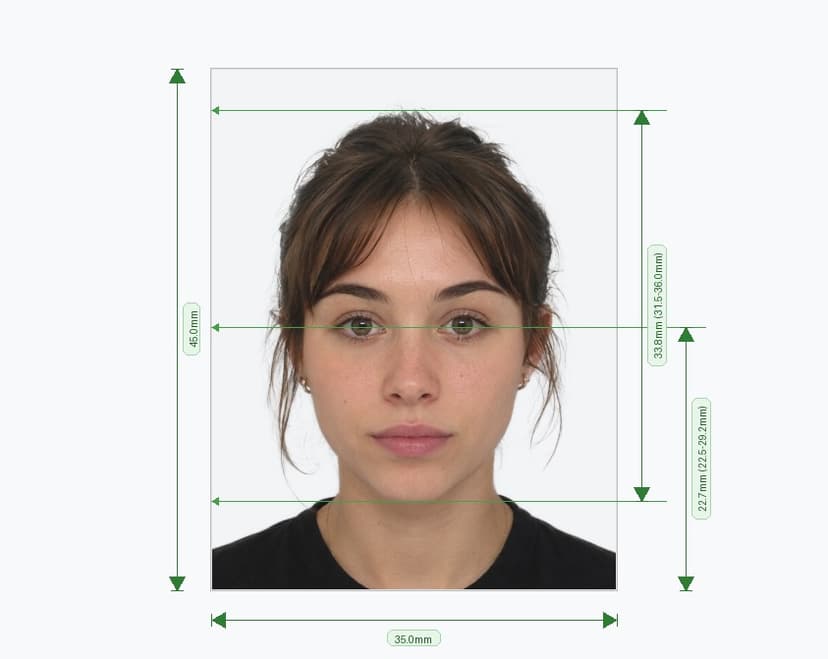
Germany Passport Photo Generator: Passbild Online in Seconds
Upload any clear photo, and this tool builds a fully compliant Passbild Deutschland in under a minute — correct 35mm x 45mm size, correct face height, and a verified light grey background, ready for your Bürgeramt appointment or a certified photo studio upload. Whether you need a biometrisches Passfoto for a passport, a Personalausweis, or an electronic residence permit, this Passfoto Generator outputs a file that matches the exact Lichtbild-Schablone every German office checks against.
How This Passfoto Online Tool Works
- Step 1 — Upload: Choose a front-facing photo taken within the last 6 months, in normal daylight if possible.
- Step 2 — Auto-crop and correct: The tool detects your face, sets the head height to 32mm-36mm, centers the eyeline, and replaces the background with a verified neutral light grey.
- Step 3 — Download: Get a 413 x 531 px JPEG at 300 dpi for digital submission, plus a printable A4 sheet where a physical copy is still accepted.
This is the fastest way to Passfoto erstellen without visiting a studio, and it works as a free first check before you commit to a certified upload — try it as Passfoto kostenlos before you download the final file.
Germany Passport Photo Size and Dimensions
Every Germany passport photo size requirement comes from the BMI and Bundesdruckerei, aligned with ICAO Document 9303. This tool builds every photo to this exact Passbild Größe Deutschland standard automatically.
| Requirement | Standard |
|---|---|
| Physical size | 35mm x 45mm |
| Digital output | 413 x 531 px, 300 dpi |
| Face height (chin to hairline) | 32mm-36mm (70%-80%) |
| Background | Plain, light, neutral grey |
| Head position | Frontal, no tilt or rotation |
| Expression | Neutral, mouth closed |
| Recency | Within 6 months |
What This Tool Fixes Automatically
- Background replacement: Swaps any wall, shadow, or texture for a uniform light grey that meets the contrast requirement for facial-recognition matching.
- Head and eye alignment: Repositions the face so it sits inside the 32mm-36mm height window without manual measuring.
- Sharpness and compression: Keeps the file crisp enough for biometric review while staying within upload size limits.
- Frontal correction: Flags any tilt or half-profile angle, since a strict frontal pose is required.
Why Use an Online Passfoto Generator Instead of a Studio
Booking a Bürgeramt slot takes time, and a wasted appointment over a rejected photo costs even more. This tool gives you a verified result before you ever leave the house.
| This Tool | Photo Studio | |
|---|---|---|
| Turnaround | Under 1 minute | Same-day, in person |
| Digital file for upload | Included automatically | Depends on studio equipment |
| Retakes | Unlimited, instant | Extra visit or fee |
| Cost | Low, one-time | Studio pricing varies |
The 2025 Digital-Only Rule
Since 1 May 2025, printed paper photos are no longer accepted for passport, Personalausweis, or eAT applications made inside Germany. Applicants now use either the terminal at the Bürgeramt or a certified studio that uploads the photo through an encrypted cloud service, handing over a data-matrix code valid for six months. This tool prepares your photo file so it is ready the moment a studio or terminal asks for it — the file just needs to meet the same specification checked above.
Works for Every German ID Document
- German passport (Reisepass) — full deutscher Reisepass Passbild specification
- Personalausweis (national ID card)
- Electronic residence permit (eAT)
- Child passport applications, with relaxed rules under age five
Common Rejection Reasons and How This Tool Prevents Them
| Rejection Reason | Fixed By This Tool |
|---|---|
| Background not light grey or uniform | Yes — automatic background replacement |
| Face height outside 32mm-36mm | Yes — automatic crop correction |
| Head tilted or half-profile | Yes — flagged for retake |
| Shadow or glare on the face | Yes — lighting correction |
| Photo older than 6 months | No — retake required |
| Sunglasses or tinted lenses | No — retake without them required |
Frequently Asked Questions
What is a Passbild and how is it different from a normal photo?
A Passbild is a biometric ID photo built to a strict German government standard — exact size, face height, background color, and expression — rather than a regular portrait photo.
Can I really get a biometrisches Passfoto for free?
Yes, you can generate and preview your photo at no cost, then download the final compliant file whenever you are ready to submit it.
Does this tool work for both passport and visa photos?
Yes, though the two use slightly different specifications. This tool detects the document type and applies the correct size and background rule automatically.
Can I wear glasses in my Passbild?
Yes, as long as your eyes stay fully visible with no glare, tint, or shadow across the lenses. Sunglasses and tinted lenses are never accepted.
Upload your photo above to generate a compliant Passbild now — correctly sized, background-corrected, and ready for your Bürgeramt appointment or certified studio upload.