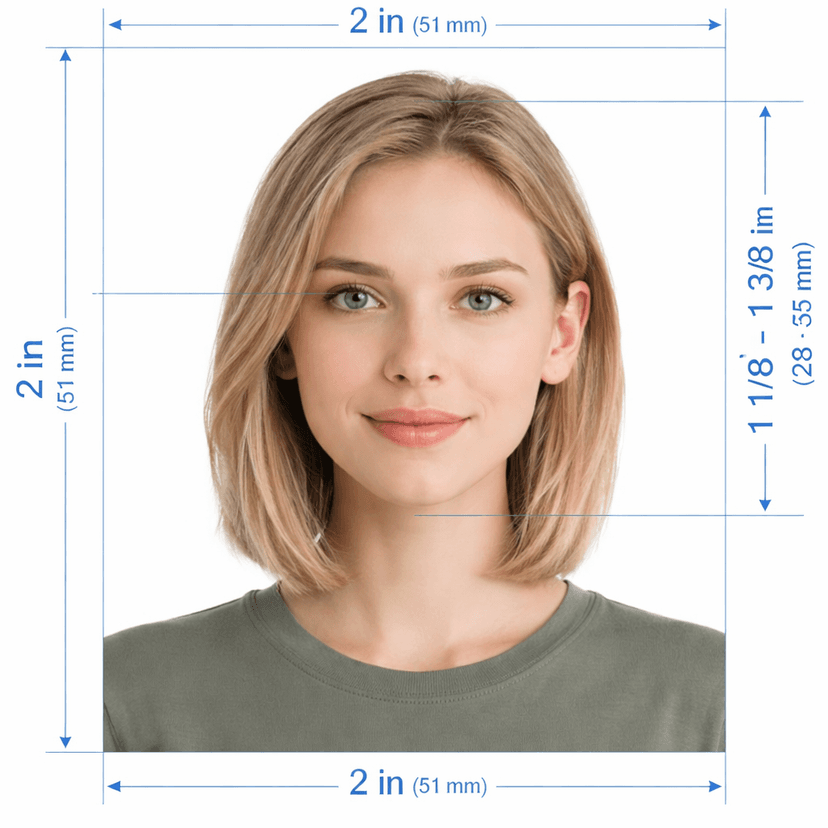
Brazilian Visa Photo (Visto Brasileiro) Requirements: A Comprehensive Consular Guide
Applying for a visa to enter the Federative Republic of Brazil—whether for tourism, business, work, or study—requires adherence to a strict set of photographic standards dictated by the Ministério das Relações Exteriores (MRE), commonly known as Itamaraty. Unlike the visa processes for the Schengen Area or the United States, which rely on a 35x45mm or 2x2 inch photo respectively, the Brazilian consular network worldwide mandates the specific and often unfamiliar 50x70mm (5x7 cm) format. This requirement applies uniformly across all visa categories, including VITEM (Temporary Visa) and VIPER (Permanent Visa). The rationale behind this larger dimension is rooted in the MRE's centralized biometric database and the need for high-fidelity facial recognition to cross-reference against INTERPOL and national security watchlists. Foreign applicants, particularly those in North America and Europe, frequently encounter visa processing delays or outright rejections due to submitting photos that are dimensionally incorrect. A common mistake is the submission of a 2x2 inch (51x51mm) photo under the assumption it is "close enough." However, Brazilian consulates employ a standardized biometric template overlay during the document screening phase. A square photo or a 35x45mm photo will not align with the required 50x70mm template, resulting in an automatic "Dimensões Incorretas" (Incorrect Dimensions) flag in the e-consular system. This flag suspends the application process and requires the applicant to resubmit compliant photography, adding significant time to the visa adjudication timeline. Understanding the specific spatial requirements of the 50x70mm canvas is therefore not merely a formality but a critical step in ensuring a smooth and expedited visa application process.
Brazilian Visa Biometric Targets & Technical Data
The Importance of Facial Proportion and the "Safe Zone" in Visa Processing
The Brazilian Ministry of Foreign Affairs utilizes advanced facial recognition algorithms known as Sistema Consular Integrado (SCI) to process visa applications. When a consular officer scans a submitted photograph, the software immediately attempts to detect the ocular centers (eyes). From this anchor point, the software calculates the required biometric template which dictates the acceptable boundary of the head. The MRE mandates that the head height—measured from the crown of the hair to the bottom of the chin—must occupy between 44% and 51% of the total 70mm vertical dimension. This translates to a physical head size of 31mm to 36mm on the printed photo. Why is this so specific? The MRE's electronic visa (e-Visa) and physical visa foil both contain a 2D barcode that encodes the applicant's facial measurements. If the submitted photo has a head size of 60% (a common occurrence when a photographer zooms in to "fill the frame" as they would for a US visa photo), the biometric data extracted by the consulate will be distorted. When the traveler arrives at a Brazilian port of entry—such as Rio de Janeiro (GIG) or São Paulo (GRU) Immigration—the live camera feed from the immigration booth will attempt to match the traveler's face against the distorted biometric record. This can lead to a "False Negative" match, causing the automated e-Gates to reject the traveler and forcing them into a secondary inspection line with a Federal Police officer. This manual verification process can take an additional 30-60 minutes, a stressful and avoidable delay after a long international flight. Our AI photo tool ensures that the facial biometrics are precisely contained within the "Zona de Segurança Biométrica" (Biometric Safe Zone), guaranteeing that the consular scanner reads the correct proportional data, thereby facilitating a seamless match at the Brazilian border.
Key Compliance Checklist for Brazilian Visa Applications (VITEM & VIPER)
Submitting a visa application to a Brazilian consulate involves a thorough document review by a consular officer. Photographs that deviate from the following criteria are the leading cause of "Exigência" (Additional Documentation Request), a formal notice that pauses the visa process clock until corrected. To ensure your application package is accepted on the first submission, adhere strictly to the following MRE guidelines:
- Expressão Facial e Posição da Cabeça (Facial Expression and Head Position): The subject must face the camera directly with a full frontal view. The head must be centered horizontally within the 50mm width, and the eyes must be aligned along a horizontal axis. Tilting the head or looking slightly to the side will cause the SCI system to fail the automated quality check. The expression must be neutral. This is a non-negotiable requirement for visa issuance. Smiling, frowning, or raising eyebrows alters the facial geometry. The mouth must be closed, and the eyes must be fully visible and open. The gaze must be directed straight at the camera lens.
- Iluminação e Fundo (Lighting and Background): The background must be a solid, uniform white with no texture, spots, or color gradients. Consular officers are trained to reject photos taken against off-white walls or in front of curtains. The lighting must be diffused to prevent harsh shadows on the face or background. A specific point of rejection for visa photos is the presence of a shadow on the neck caused by overhead lighting. The subject should be illuminated from the front with a soft light source to ensure the facial features are rendered without distortion. Additionally, the photo must be free of "red-eye" caused by flash photography. Our digital processing automatically corrects red-eye and removes background blemishes to meet the rigorous MRE standards.
- Óculos e Acessórios (Glasses and Accessories): Following updated guidelines aligned with ICAO recommendations, the Brazilian MRE advises against wearing glasses in visa photos. Even if you wear prescription glasses daily, the consulate recommends removing them for the biometric capture. The reason is twofold: frames can obscure the ocular biometric pattern, and lens glare can completely wash out the iris detail. If glasses must be worn for undisputed medical reasons, a signed medical certificate from an ophthalmologist must be included in the visa application package, and the photo must show absolutely no glare or tinting. The eyes must be clearly visible through the lenses, and the frames must not cover any part of the eye itself. Jewelry that obscures the jawline or ears is also prohibited.
- Qualidade da Impressão e Submissão Digital (Print Quality and Digital Submission): For consular applications requiring in-person interviews, a physical 50x70mm photo printed on high-quality matte paper is required. Photos printed on standard office paper using an inkjet printer are not acceptable as they lack the resolution and contrast needed for scanning. For the Brazilian e-Visa (electronic visa available for eligible nationalities), the digital file must be uploaded directly to the sistema consular. The portal has strict requirements: the file must be in JPEG format, the size must not exceed 2MB, and the dimensions must be exactly 945x1323 pixels. Uploading a smaller file or a PNG will result in a system error. Our service provides the exact 945x1323 JPEG file required, correctly compressed to balance quality and file size constraints.
The High Cost of a Rejected Visa Photo
The stakes for a rejected visa photo are considerably higher than for a passport photo. While a passport rejection merely delays an appointment, a visa photo rejection can have cascading consequences. Brazilian consulates operate on a strict appointment and processing schedule. If an application is placed on hold due to a photo issue (Exigência de Foto), the applicant is given a limited window (often 10-15 days) to submit a corrected photo. If the new photo does not arrive in that window, the visa application is automatically arquivado (archived/abandoned). The applicant forfeits the non-refundable consular fee and must initiate an entirely new application, which includes paying the fee again and re-entering the queue. For business travelers or those with imminent travel dates, this bureaucratic limbo can result in missed flights, cancelled meetings, and significant financial loss. Furthermore, a history of "Non-Compliant Document Submission" can be noted in the consular system, potentially flagging the applicant for increased scrutiny on future visa applications to Brazil. By utilizing a specialized tool calibrated to the MRE's exacting 50x70mm specifications, you mitigate the risk of administrative delay and protect your travel investment.
Digital Submission for the E-Visa: Pixel Perfect Requirements
In recent years, Brazil has expanded its electronic visa program, allowing citizens of strategic partner nations (including the United States, Canada, Australia, and Japan) to apply for a tourist visa entirely online. While this streamlines the process by eliminating the need to visit a consulate in person, it places the entire burden of biometric compliance on the applicant's ability to submit a perfect digital file. The e-Visa portal uses an automated pre-validation algorithm that checks the uploaded photo before the application is even assigned to a human officer. This algorithm is particularly sensitive to the aspect ratio and pixel dimensions. A photo with dimensions of 900x1300 pixels will be rejected instantly for "Incorrect Image Dimensions." Our generated file is precisely 945 pixels wide by 1323 pixels high. This is the mathematical equivalent of 50mm x 70mm at 300 DPI (Dots Per Inch). Furthermore, the file is encoded with an sRGB color profile, which is the standard for web and consular systems. Using a photo with an Adobe RGB or ProPhoto color space can result in color shifts when viewed on the consular monitor, making a white background appear pink or gray. By standardizing the output to sRGB and precise pixel geometry, we ensure that the image you see on your screen is exactly the image the consular officer sees on theirs. This technical precision removes the guesswork from the e-Visa application, allowing travelers to focus on their itinerary rather than the nuances of Brazilian immigration software.
Adapting to the Unique 50x70mm Canvas for Visa Purposes
It is crucial for visa applicants to understand the visual difference between a 50x70mm photo and the standard 2x2 inch photo used for US passports. In a 2x2 photo, the subject's head typically occupies 50-69% of the frame, but the frame itself is a square. When a US photographer or a retail drugstore photo booth attempts to take a "Brazilian visa photo," they often default to placing the subject's head too high in the frame or too close to the camera. The result is a 50x70mm photo with a head size of 55% or greater—a certain rejection. The extra vertical space in the 70mm height is intended to be above the head, not below the chin. The MRE requires this headroom for the same reasons as the PF: the visa stamp or sticker contains security elements that must not overlay the facial image. When our AI processes your selfie or uploaded portrait, it does not simply crop a 5x7 rectangle; it identifies the top of the head and positions it exactly 7-10mm from the top edge of the 70mm canvas. This ensures that your eyes fall within the 50-65% range of the photo height (another critical MRE metric), guaranteeing that the resulting image is not only the right size but also correctly composed for consular approval. Whether you are applying for a VITEM I (Research/Academic), VITEM II (Health Treatment), or a standard tourist visa, this level of compliance is the baseline expectation of the Ministério das Relações Exteriores.