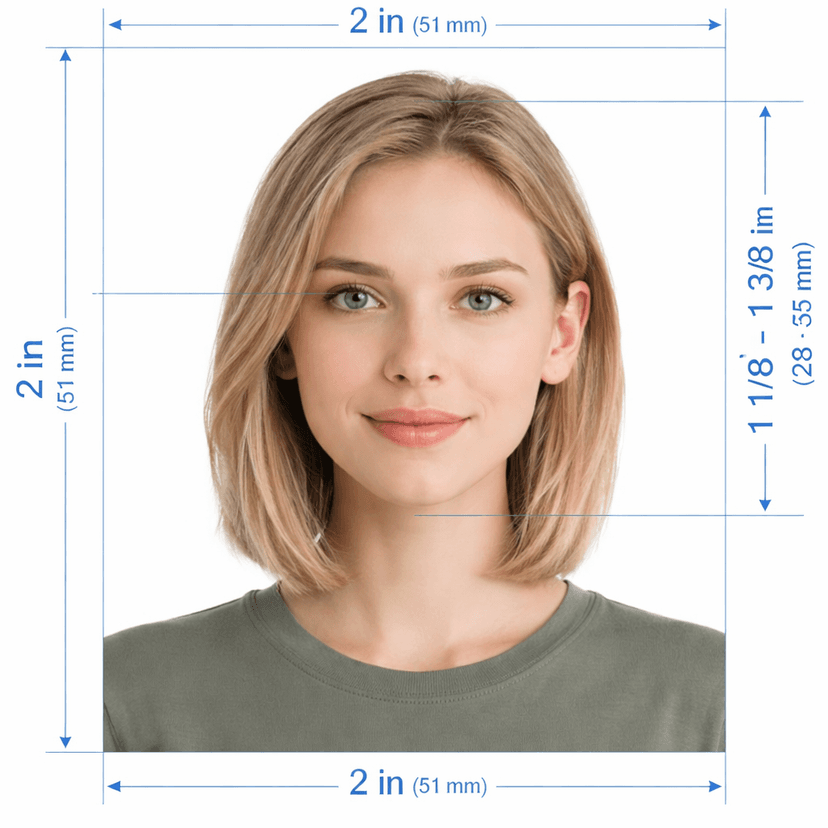
Brazilian Passport (Passaporte Brasileiro) Photo Specifications: The Complete 50x70mm Guide
Navigating the requirements for the Brazilian Passport, officially known as the Passaporte Brasileiro and issued exclusively by the Polícia Federal (PF), presents a unique challenge for citizens both at home and abroad. Unlike the vast majority of nations that adhere to the ICAO standard of 35x45mm or the US standard of 2x2 inches, Brazil mandates one of the largest and most distinct photo formats in global travel documentation: the 5x7 cm (50x70mm) photograph. This expansive vertical orientation is not merely a bureaucratic quirk; it is a deliberate design feature engineered to accommodate specific anti-fraud measures and high-security laminates used in the Brazilian passport book. Understanding the nuances of this size—particularly the counter-intuitive head placement—is the single most important factor in avoiding appointment cancellation and application rejection. The primary pitfall for 90% of applicants is a natural, yet incorrect, tendency to fill the frame. In standard portrait photography, a face occupying 70-80% of the vertical space is considered well-composed. For the Brazilian Passport, this is an immediate disqualification. The Polícia Federal strictly enforces a facial biometric range of 44% to 51% of the total 70mm frame height. This leaves an unusually large amount of empty white space above the applicant's head—often referred to as "headroom"—which feels unnatural to the untrained eye but is absolutely mandatory for the laminating process. If the head exceeds the 51% threshold, the high-security holographic overlay and the embedded RFID antenna will intersect with the facial image, obscuring key biometric features and rendering the document invalid at both Mercosul and international eGate scanners.
Brazil Technical Specifications & Digital Dimensions
Deep Dive: The Critical 44-51% Head Ratio and Holographic Laminate
The technical justification for the 50x70mm photo size lies in the construction of the Brazilian passport's data page. Governed by Decreto nº 8.939/2017, the document features a polycarbonate data page with a recessed area specifically milled for a 50x70mm photograph. Following the placement of the photo, a layer of complex holographic laminate is heat-sealed over the entire page. This laminate includes a repeating pattern of the Southern Cross constellation and the word "BRASIL." For this seal to be effective and tamper-proof, the laminate requires a clear, unprinted border of approximately 7mm to 10mm around the entire facial image. If the applicant's head is too large—encroaching into the upper 30% of the photo—the facial features will be directly overlapped by the laminate's strongest holographic refraction points. This causes a visual obstruction known as "moiré pattern interference" when scanned by optical readers at airports like Guarulhos (GRU) or Galeão (GIG). Therefore, the seemingly excessive white space above the head is, in fact, a functional security zone. Our AI-driven cropping algorithm is uniquely calibrated to detect the crown of the head (not just the hairline) and apply a 7-10mm offset buffer. This ensures that the printed photo will integrate seamlessly with the Polícia Federal's laminating machinery, preserving the clarity of your eyes, nose, and mouth while maintaining the integrity of the document's anti-fraud features. Attempting to submit a photo taken at a standard international booth that forces a tight crop will result in the agent at the PF post immediately measuring the photo with a template overlay and rejecting it on sight.
Checklist de Conformidade: Avoiding Automatic Rejection at the Polícia Federal
Securing an appointment with the Polícia Federal can be a competitive and time-consuming endeavor, with wait times stretching for weeks or even months depending on the region. Arriving at your scheduled biometrics appointment with a photograph that fails inspection is not merely a minor inconvenience; it results in the immediate cancellation of your appointment slot. You will be required to leave the facility, obtain a compliant photo, and re-enter the scheduling queue from scratch. To ensure your first visit is your only visit, adhere strictly to the following checklist curated from official PF internal guidelines:
- Expressão Facial / Facial Expression: The Polícia Federal maintains a zero-tolerance policy regarding smiles. The directive is explicitly "boca fechada" (closed mouth) and "expressão neutra" (neutral expression). Even a slight upward curve of the lips that hints at a smile is grounds for rejection. This is due to the biometric matching software used by the PF, which measures the distance between the pupils and the corners of the mouth. A smile alters the baseline position of the mouth corners, potentially causing a mismatch with the facial recognition data captured at the border. Teeth must not be visible under any circumstances.
- Iluminação e Fundo / Lighting and Background: The background must be 255, 255, 255 White. Off-white, cream, or grayish backgrounds are flagged by the PF's high-resolution document scanners. Furthermore, the lighting must be absolutely diffused and even. Shadows are strictly prohibited—especially behind the ears and under the chin. The PF scanners are calibrated to detect "vignette" effects (darkening at the edges of the photo). Because the Brazilian photo is so large (70mm high), poor lighting in a home environment often results in a visible shadow at the top of the frame or on the neck. Our tool applies a uniform white balance and shadow removal pass to ensure the background is a consistent, flat field of pure white.
- Vestimenta / Attire: Given the requirement for a pure white background, wearing a white shirt or blouse is strictly prohibited. The garment will blend into the background, causing the facial recognition software to miscalculate the head outline and shoulder placement. The resulting image will look like a floating head with no neck or torso definition, which violates the ICAO specifications adopted by Brazil. Dark or colored clothing with a distinct neckline is required. Religious head coverings are permitted but must not cast any shadows on the face and must not cover any part of the jawline or chin.
- Acessórios / Accessories: Glasses are strongly discouraged. Even if you wear them daily, the PF recommends removal for the photo. Anti-reflective coatings often fail under the intense flash of the PF's capture system, resulting in glare that obscures the iris. If you cannot remove glasses for medical reasons, you must provide a signed medical statement at the time of the appointment and ensure there is zero glare and the frames do not intersect the eye at any point.
Evite Filas e Rejeições no Agendamento: The Cost of a Wrong Photo
The logistical and financial impact of a rejected photo is significant. Consider the scenario: You have taken a day off work to attend your Polícia Federal appointment. You present a 35x45mm photo (the standard in Europe and many South American neighbors) or a 50x70mm photo where your face is 60% of the height. The agent immediately hands it back. Your appointment is marked as "NÃO COMPARECIMENTO POR FALTA DE DOCUMENTAÇÃO" (Non-appearance due to lack of documentation). You are now required to schedule a new appointment using the online portal, potentially waiting another 30 to 60 days for availability. If you are traveling abroad, this delay can derail international travel plans and visa applications for other countries. Our service eliminates this risk entirely by generating a file that adheres pixel-perfectly to the Portaria MJSP nº 245/2024 specifications. The printable A4 layout includes cutting guides specifically measured for a 50x70mm rectangle, ensuring that when you hand the physical photo to the agent, it drops perfectly into their measurement template, keeping your appointment on track and your passport issuance on schedule.
Digital Upload vs. Physical Print: Navigating the Brazilian Passport Application Workflow
There is a common misconception regarding the digital pre-application step. While the Polícia Federal's website allows for the uploading of a digital photo to pre-populate the application form, this is not a substitute for the physical photograph. The digital upload serves only to expedite the data entry process by the clerk. The actual passport book is manufactured using a physical, printed photograph that is physically heat-sealed into the polycarbonate page. Therefore, even if your digital upload is accepted by the website's rudimentary file size checker, you must still bring a high-quality, physical 50x70mm print to your in-person biometrics appointment. Failure to present a physical photo, regardless of what you uploaded online, results in the cancellation of the issuance process. The physical photo must be printed on high-quality matte or semi-matte photo paper. Glossy paper is prohibited as it can reflect the laminator's heat source, causing bubbles in the final passport page. Our system provides a downloadable PDF layout optimized for standard A4 paper (common in Brazil and internationally) with precise alignment markers. When cut along these guides with a sharp blade or scissors, the resulting photo will measure exactly 50mm wide by 70mm high, with the subject's face perfectly positioned within the 44-51% tolerance zone, guaranteeing acceptance by the federal agent.
The Evolution of the Brazilian Passport Photo Standard
It is worth noting that the 50x70mm standard has been in place for decades, predating the current digital era. The decision to retain this larger format while the rest of the world moved toward the smaller 35x45mm ICAO standard was a conscious one by the Brazilian government. The larger surface area provides a much higher resolution image of the applicant's face when printed at 300 DPI. This higher resolution is crucial for the visual inspection performed by border agents who compare the physical photo to the laser-engraved ghost image elsewhere on the data page. Furthermore, the larger white space allows for the inclusion of intricate offset printing patterns and micro-text behind the photo, which are visible only under UV light. When you use our service, you are not just getting a cropped image; you are receiving a file formatted to complement these advanced security features. The 945x1323 pixel digital file preserves the fine details of facial features (pores, iris patterns) that are essential for both human and machine verification, ensuring your Brazilian passport meets the highest standards of the Organização da Aviação Civil Internacional (ICAO) as implemented by the Departamento de Polícia Federal.