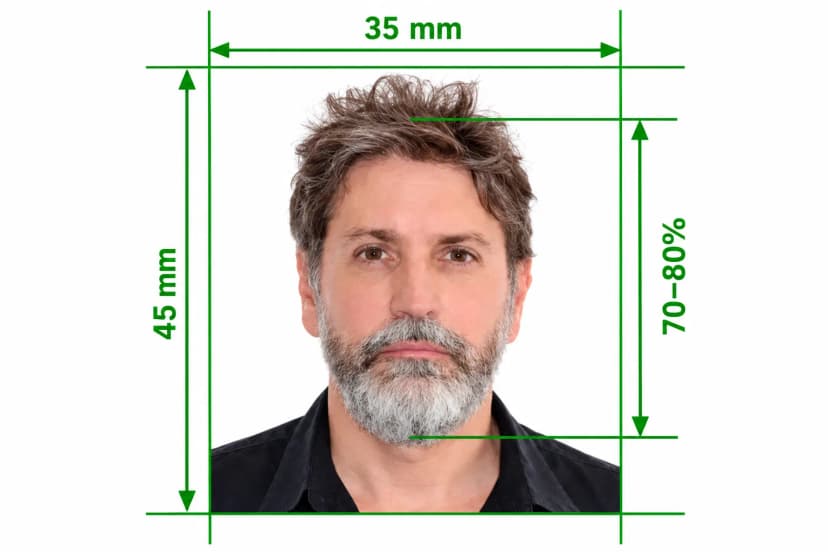
Create a Schengen visa photo online. Upload your photo, and our editor adjusts the size, crop, background and framing to meet the Schengen visa photo requirements. You preview the result with measurement guides before you download anything.
Create Your Schengen Visa Photo Online
Our Schengen visa photo tool turns a phone photo into a correctly sized, print-ready visa photo in about two minutes. Follow the steps below.
Upload Your Photo
Take a straight-on photo in even light, with a neutral expression and your eyes open. Upload it from your phone or computer.
Automatically Crop and Resize
The editor crops your photo to 35×45 mm and exports it at 413×531 pixels, 300 DPI.
Adjust the Background
The tool replaces your background with a plain, uniform light gray and removes shadows, texture and color variation.
Check Face Position and Framing
The checker confirms that your head fills 70% to 80% of the photo height and that your eyes sit between 56% and 69% from the bottom edge.
Download Your Schengen Visa Photo
Download your digital file or a printable A4 sheet for €6.99.
Schengen Visa Photo — Quick Specs
Schengen Visa Photo Requirements
Schengen countries share a common framework for visa photographs, based on ICAO biometric standards. Individual consulates and application centers can add their own instructions, so always check the rules for your destination country.
Schengen Visa Photo Size
The standard Schengen visa photo size is 35×45 mm. This format applies to most applications. Each consulate or application center may add instructions on printing, number of copies or digital upload, so confirm the details with the one that handles your application.
Schengen Visa Photo Dimensions
Use the table below to convert the standard Schengen photo size between units.
| Unit | Width × Height |
|---|---|
| Millimeters | 35 × 45 mm |
| Centimeters | 3.5 × 4.5 cm |
| Inches | 1.38 × 1.77 in |
| Pixels (300 DPI) | 413 × 531 px |
Schengen Visa Photo Background
The background must be plain, uniform and free of shadows, patterns and objects. Our tool uses a clean light gray background, which keeps the contrast with your face and hair clear. Some applicants search for a Schengen visa photo with a white background. Check your consulate's instructions, because white is not the safe choice everywhere.
Schengen Visa Biometric Photo Requirements
EU rules link the Schengen visa photograph to ICAO biometric standards. Visa photos feed into biometric systems, so the geometry must be precise:
- Head height of 70% to 80% of the photo
- Eye line between 56% and 69% from the bottom
- Face centered and looking straight at the camera
- Neutral expression with the mouth closed
- No shadows on the face or the background
Schengen Visa Photo Quality Requirements
Even a correctly sized photo fails when the image quality is poor. Make sure your photo meets these points:
- Sharp and in focus
- Natural skin tones
- Even lighting with balanced brightness and contrast
- No creases, marks or pixelation
- Direct view of the camera, with no head tilt
- Head and top of the shoulders in frame
How to Make a Schengen Visa Photo Online
Step 1 – Upload Your Photo
Choose a recent, front-facing photo from your phone or computer.
Step 2 – Crop and Position Your Face
The editor detects your facial landmarks and positions your head and eyes to the required proportions.
Step 3 – Set the Required Background
The tool swaps in a uniform light gray background automatically.
Step 4 – Check the Photo
Review the preview with measurement guides. The checker shows whether your head size and eye line fall within the required range.
Step 5 – Download or Print
Download the 413×531 px file or the printable A4 sheet.
Schengen Visa Photo Requirements Checklist
- Recent photograph, taken within the last six months
- Face looking directly at the camera
- Natural skin tone
- Sharp and clear image
- Appropriate brightness and contrast
- Head and shoulders framed correctly
- Plain, suitable background
- High-quality print when a physical photograph is required
- Instructions of your consulate or visa application center followed
Common Reasons Schengen Photos Get Rejected
- Smiling or an open mouth
- Shadows or texture on the background
- Glasses with glare, or frames that cover the eyes
- Hair covering part of the face
- An old photo that no longer looks like you
- Head too small or too large in the frame
Our checks catch the geometry and background issues. You control the rest when you take the source photo.
Can I Use a Passport Photo for a Schengen Visa?
Yes, if the photo meets the current Schengen visa photograph requirements. Many passport photos share the 35×45 mm format, but do not assume that any ordinary passport photo qualifies. Differences in background color, head size or image quality can lead to rejection. Use our editor to confirm that your passport photo for a Schengen visa meets every measurement.
Schengen Visa Photo for VFS
VFS Global is an application-service provider, not the authority that sets the rules. Requirements for a Schengen visa photo at VFS depend on the country you apply to and on the specific application center. Check the instructions for your destination, then use our tool to prepare a photo that matches the standard 35×45 mm format.
Schengen Visa Photo Printing
Many application centers still ask for a printed photo, and some request two identical copies. Create a printable Schengen visa photo sheet in one click. We format the file for A4 paper at 300 DPI, so any print shop can produce sharp copies without re-cropping. You can also print at home on photo paper with a good color printer. Use glossy or matte photo paper, avoid ink smudges, and do not fold or staple the print.
Schengen Visa Photo FAQ
What size should a Schengen visa photo be?
The standard size is 35×45 mm, or 413×531 pixels at 300 DPI. Check your consulate for any extra instructions.
What are the photo requirements for a Schengen visa?
The photo must be recent, sharp and in natural color. You must face the camera directly with a neutral expression, in front of a plain background, with your head and shoulders in frame.
Can I create a Schengen visa photo online?
Yes. Upload your photo to our editor, and it crops, resizes and adjusts the background for you in about two minutes.
Can I use a passport photo for a Schengen visa?
You can, if it meets the current Schengen photo requirements. Verify the size, background and quality first.
Does a Schengen visa photo need a white background?
Not necessarily. The background must be plain and uniform. Our tool uses light gray, and your consulate may specify a different shade.
Can I use a digital photo for a Schengen visa application?
Yes, when your application route accepts uploads. Our 413×531 px file at 300 DPI suits most digital submissions.
Can I use my phone to take a Schengen visa photo?
Yes. Use good, even light, hold the phone at eye level, and stand in front of a plain wall. Then upload the photo to our editor.
Does the Schengen visa photo need to be biometric?
Yes. EU rules tie Schengen visa photographs to ICAO biometric standards, so head size, eye position and expression matter.
Can I print my Schengen visa photo at home?
Yes. Print our A4 sheet at 300 DPI on quality photo paper, and cut the photos to 35×45 mm.
Does VFS require a specific Schengen visa photo size?
VFS follows the rules of the country you apply to. Check the instructions for your application center, and use the 35×45 mm standard as your starting point.