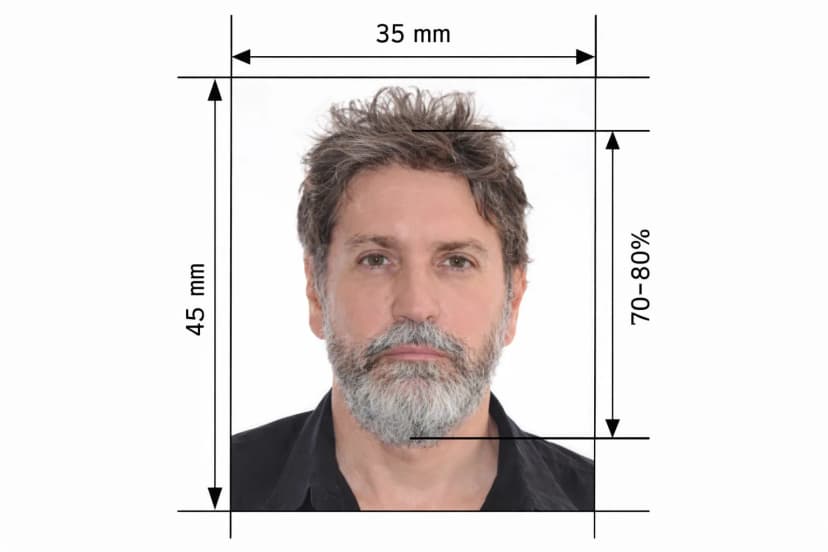
Pasaporte Chileno: Mastering the 45x45mm Square Photo with 60% Head Ratio
The Chilean passport, issued exclusively by the Servicio de Registro Civil e Identificación (SRCeI), stands as one of the most technically demanding travel documents in the Americas regarding photographic compliance. While many nations have transitioned to the standard rectangular ICAO format of 35x45mm, Chile retains a distinct and precise requirement: a perfect 45x45mm square photograph. This is not merely a different shape; it represents a fundamental shift in biometric capture philosophy. Unlike the variable head tolerances seen in Brazil (44-51%) or the USA (50-69%), the Chilean system operates on a fixed-point biometric algorithm. The specifications mandate that the applicant's head—measured from the crown of the hair to the lowest point of the chin—must occupy exactly 60% of the total 45mm frame height. This translates to a physical head height of precisely 27 millimeters. A deviation of even a single percentage point, resulting in a head height of 26mm (58%) or 28mm (62%), is sufficient grounds for the automated optical scanner at the Registro Civil to flag the application as "Foto No Conforme." This strictness is rooted in the technology of the Chilean e-passport chip and the centralized database managed by the Clave Única system. The encryption algorithm used to store the facial template on the chip relies on a fixed spatial reference grid. If the face is too large within the square canvas, the outer boundary points (jawline and crown) are clipped in the algorithmic hash, making the biometric template incomplete. If the face is too small, the pixel density of the iris pattern falls below the threshold required for positive identification at automated border control gates (e-Gates) at Santiago's Aeropuerto Arturo Merino Benítez (SCL). Therefore, achieving this precise 60% ratio is not just a guideline; it is a technical prerequisite for the issuance of a valid Chilean biometric passport.
Especificaciones Técnicas de Chile: Dimensiones Digitales y Físicas
Why Exactly 60%? The Science Behind the Chilean Biometric Algorithm
The insistence on a fixed 60% head ratio by the Registro Civil e Identificación is a direct result of the specific tokenisation algorithm employed in the production of the Chilean electronic passport. During the enrollment process, known locally as "Captura Biométrica", the officer scans the physical 45x45mm photo using a high-fidelity flatbed scanner integrated with proprietary software. This software does not simply store a JPEG image. Instead, it immediately performs a geometric analysis of the face. It identifies nodal points—specifically the interpupillary distance, the width of the nose bridge, and the distance from the eye line to the chin. The software is hard-coded to expect these measurements to be proportional to a face that measures 27mm in vertical height on the 45mm canvas. If the face height is off, the software attempts to digitally re-scale the image to fit its expected parameters. However, this digital scaling introduces interpolation artifacts (blurring or pixelation), which the system is trained to reject as potential fraud indicators. This is why a photo taken at a generic photo booth that simply crops a 45x45 square without measuring the head size will inevitably fail. Our AI algorithm is specifically trained to detect the true anatomical crown of the head (distinct from stray hairs) and the lowest point of the chin shadow. It then mathematically scales and positions the subject within the 1063x1063 pixel canvas so that the face height registers at exactly 638 pixels—which corresponds to the required 27mm (60%) when printed. This pixel-perfect precision eliminates the risk of digital scaling rejection by the Registro Civil's capture station.
Lista de Verificación para Pasaporte Chileno: Cumplimiento Estricto
Navigating an appointment with the Registro Civil in Chile can be a streamlined experience provided your documentation is flawless. However, presenting a non-compliant photograph leads to the immediate suspension of the process. To ensure your application proceeds without a hitch, observe the following mandatory checklist derived from the official Manual de Normas Gráficas of the SRCeI:
- Expresión Facial (Facial Expression): The requirement is strictly defined as "Expresión Neutra" (Neutral Expression). The subject must look directly at the camera lens with both eyes equally visible and open. The mouth must remain completely closed, with the jaw relaxed. Any upward or downward curve of the lips, showing of teeth, or raised eyebrows will distort the biometric nodal points. This is particularly crucial for the 60% measurement, as a smile lifts the chin and alters the head height calculation.
- Iluminación y Fondo (Lighting and Background): The background must be a flat, pure white surface (Hex Code: #FFFFFF). The SRCeI uses high-intensity scanners that are exceptionally sensitive to vignetting (darkened corners) and shadows. Because the photo is a square, there is less margin for error in the corners. Any shadow cast behind the ears or under the chin will be captured and flagged. The lighting must be diffused and frontal. Overhead lighting that creates a shadow on the neck is a primary cause of rejection in Chilean passport applications.
- Vestimenta (Attire): Due to the required white background, wearing white, cream, or very light beige clothing is strictly prohibited. The torso and shoulders of the subject must be clearly distinguishable from the background. Dark-colored tops—navy blue, black, charcoal gray, or deep burgundy—are strongly recommended. This provides a high-contrast frame for the 60% head area, making it easier for the automated cropping algorithm to identify the face boundaries.
- Accesorios y Cabello (Accessories and Hair): Hair must be pulled back from the face. The forehead and the entire oval of the face from temple to jaw must be completely unobstructed. This is essential for the accurate measurement of the 60% head height. Head coverings are only permitted for verified religious reasons and must not cast any shadow or cover the jawline. Glasses are strongly discouraged. The thick frames and anti-reflective coatings common in Chilean optics often create glare or obscure the iris pattern, leading to a biometric mismatch. If glasses are medically unavoidable, a signed statement from an ophthalmologist must be presented at the time of the appointment, and the photo must show absolutely zero glare or refraction.
Precisión Milimétrica: Evite el Rechazo en el Tótem de Autoatención
Many Registro Civil offices now utilize self-service kiosks (Tótems de Autoatención) for document renewal. These kiosks include a high-resolution camera that can capture your photo on the spot. However, many citizens prefer to bring a professional photo to ensure the best possible likeness for the next 5 to 10 years. If you choose to bring a photo, it is measured with a digital caliper by the kiosk software. Generic photo editing apps that crop to 45x45 often fail to position the head correctly. Our tool is engineered to output a file calibrated to the exact 60% biometric grid used by the Chilean state. This guarantees that whether your photo is scanned by a human clerk or an automated kiosk in Providencia or Valparaíso, it will be instantly accepted, preserving your appointment time and expediting the issuance of your Cédula de Identidad and Pasaporte.
The Relationship Between Physical Print and Digital Biometric Capture
There is a common misunderstanding among Chilean applicants regarding the necessity of the physical photo. While the Clave Única system allows for some online pre-registration, the actual passport manufacturing process at the centralized facility requires a physical scan of a printed photograph. The print must be on high-quality, matte-finish photographic paper. Glossy paper causes reflections that bounce off the scanner's laser, creating white spots on the digital record. The print must also be free of creases, ink smudges, or staple holes. When using our printable A4 layout, the file is structured to provide a 45x45mm image with precise cutting guides. When cut accurately with a sharp paper trimmer, the resulting physical photo will measure exactly 45mm x 45mm, and the embedded AI data ensures the face will measure exactly 27mm (60%). This alignment between the physical artifact and the digital biometric expectation is the cornerstone of a successful Chilean passport application. Failure to meet this standard results in the application being classified as "Observado" (Flagged), requiring a return visit to the Registro Civil and resetting the processing timeline.