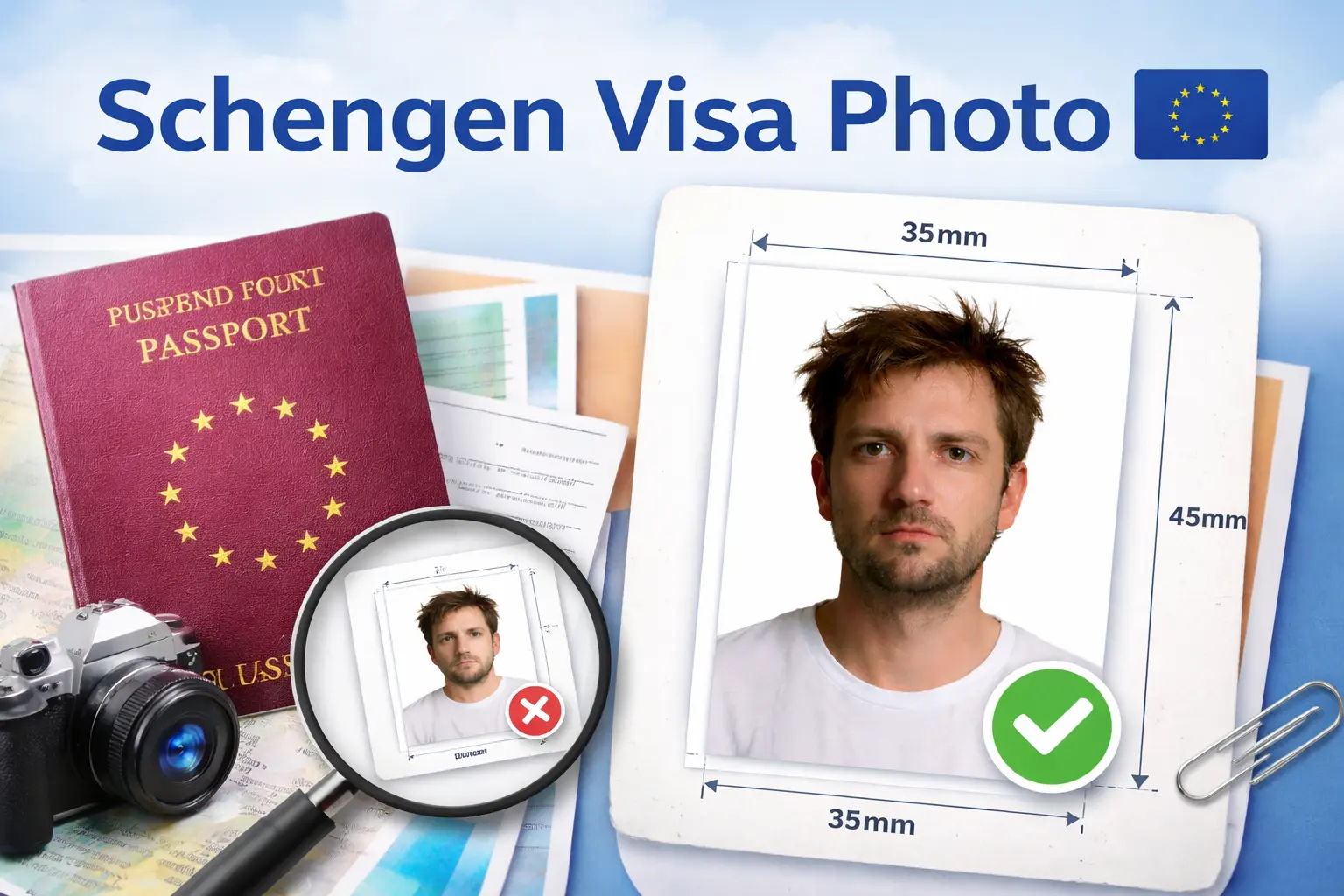
Schengen Visa Photo: The Complete 2026 Requirements Guide
Your Schengen visa photo is the first thing a consulate officer reviews. Get it wrong — wrong size, shadows, or a colored background — and your entire application can be delayed or rejected before it's even assessed. The rules are strict, standardized across all 27 Schengen member states, and enforced using biometric software that catches errors automatically.
This guide covers every official Schengen visa photo specification for 2026: correct dimensions, background color, face position, dress code, and the best way to use a free Schengen visa photo maker tool to generate a compliant image in under two minutes — without leaving your home.
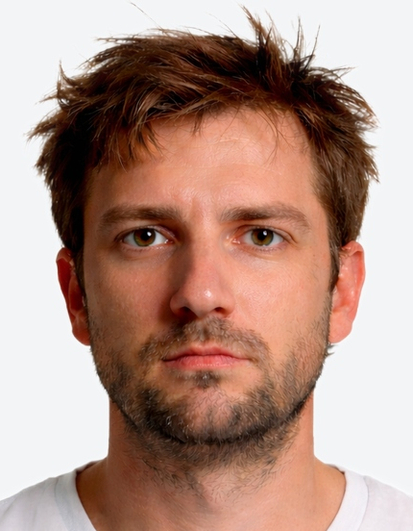
Who Needs a Schengen Visa?
The Schengen Area covers 27 European countries — including France, Germany, Spain, Italy, the Netherlands, and Switzerland — that share open internal borders. A single Schengen visa allows you to travel freely within this entire zone for up to 90 days in any 180-day period.
Citizens of many countries, including India, China, Nigeria, Pakistan, and most of Southeast Asia, must apply for a Schengen visa before traveling. Nationals of the US, UK, Canada, and Australia are currently exempt for short tourist stays, but may still need a visa for long-stay or work purposes. Regardless of your nationality, if you need a Schengen visa photo, the specifications below apply to you.
Schengen Visa Photo Size: The Official Specifications
The Schengen visa photo size follows the ICAO (International Civil Aviation Organization) biometric standard, adopted uniformly across all member state consulates.
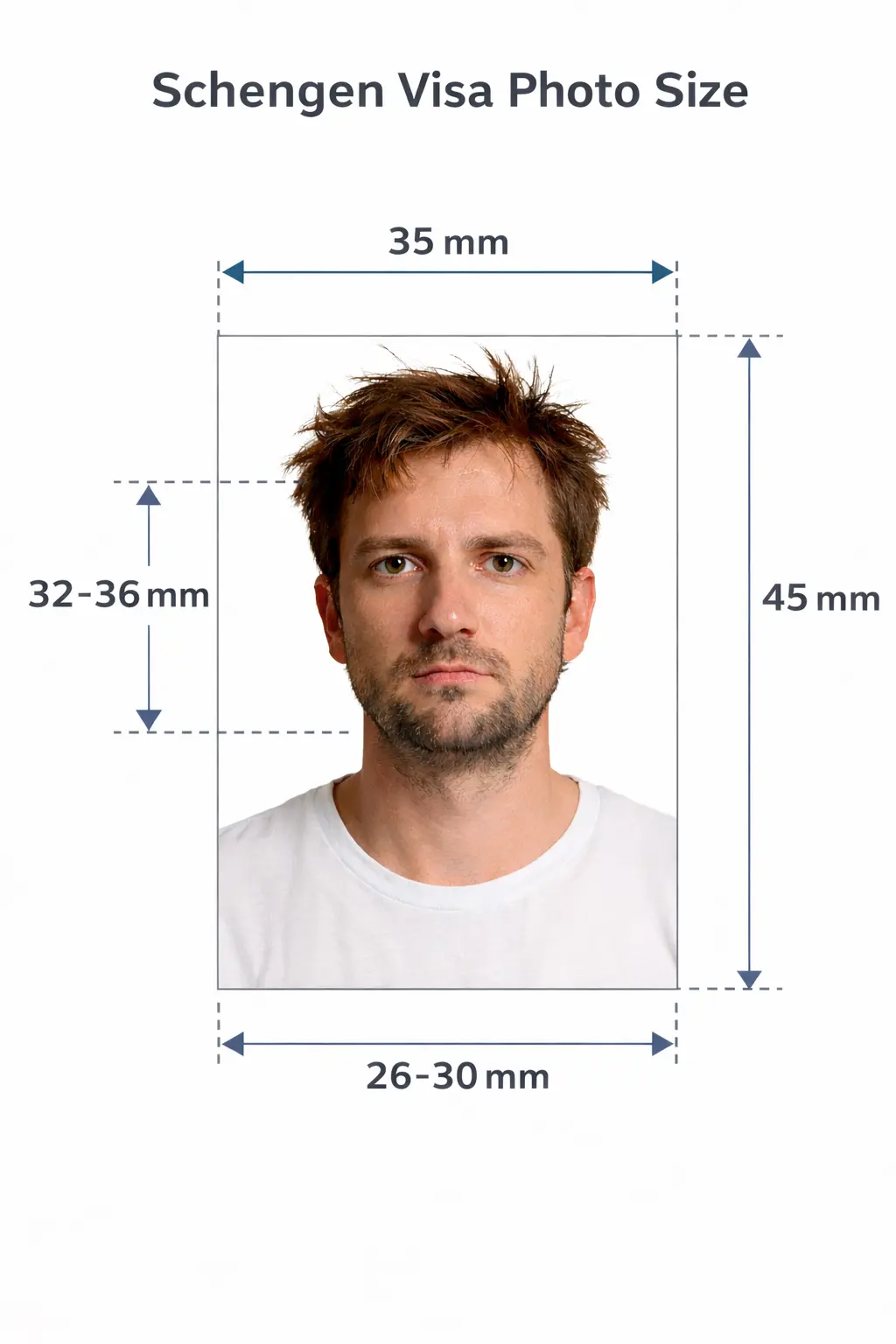
- Dimensions: 35 mm wide × 45 mm tall
- Schengen visa photo size in cm: 3.5 cm × 4.5 cm
- Digital equivalent: 413 × 531 pixels at 300 DPI
- Face height: 32–36 mm (chin to crown of head)
- Face coverage: 70–80% of total photo height
- Format: Color JPEG for digital; matte or semi-gloss print for physical submission
- Recency: Taken within the last 6 months
This is a rectangular portrait format — taller than it is wide — unlike the square US visa photo. Submitting a cropped square image, even at the correct face ratio, will result in an immediate rejection. Always confirm the exact digital pixel dimensions required by the specific embassy portal you are submitting to, as some VFS Global and BLS submission systems may specify slightly different pixel values while maintaining the same 35×45mm aspect ratio.
Background Requirements: White Only
The background in your Schengen visa photo must be plain white or very light grey. This is one of the most frequently failed requirements — and one of the easiest to fix with the right tool.
- Solid white or near-white — no cream, beige, blue, or pastel tones
- No shadows cast from your head or shoulders
- No objects, walls, furniture, or patterns in the frame
- Evenly lit — no bright hotspots or dark corners
If you're shooting a DIY Schengen visa photo at home, stand at least 1 metre away from the wall to prevent shadow. Diffused natural light from a window directly in front of you works well. Avoid harsh overhead or side lighting. Alternatively, a free Schengen visa photo editor with AI background removal can instantly replace any background with the correct white — making DIY much more reliable.
Face Position, Expression, and Lighting Rules
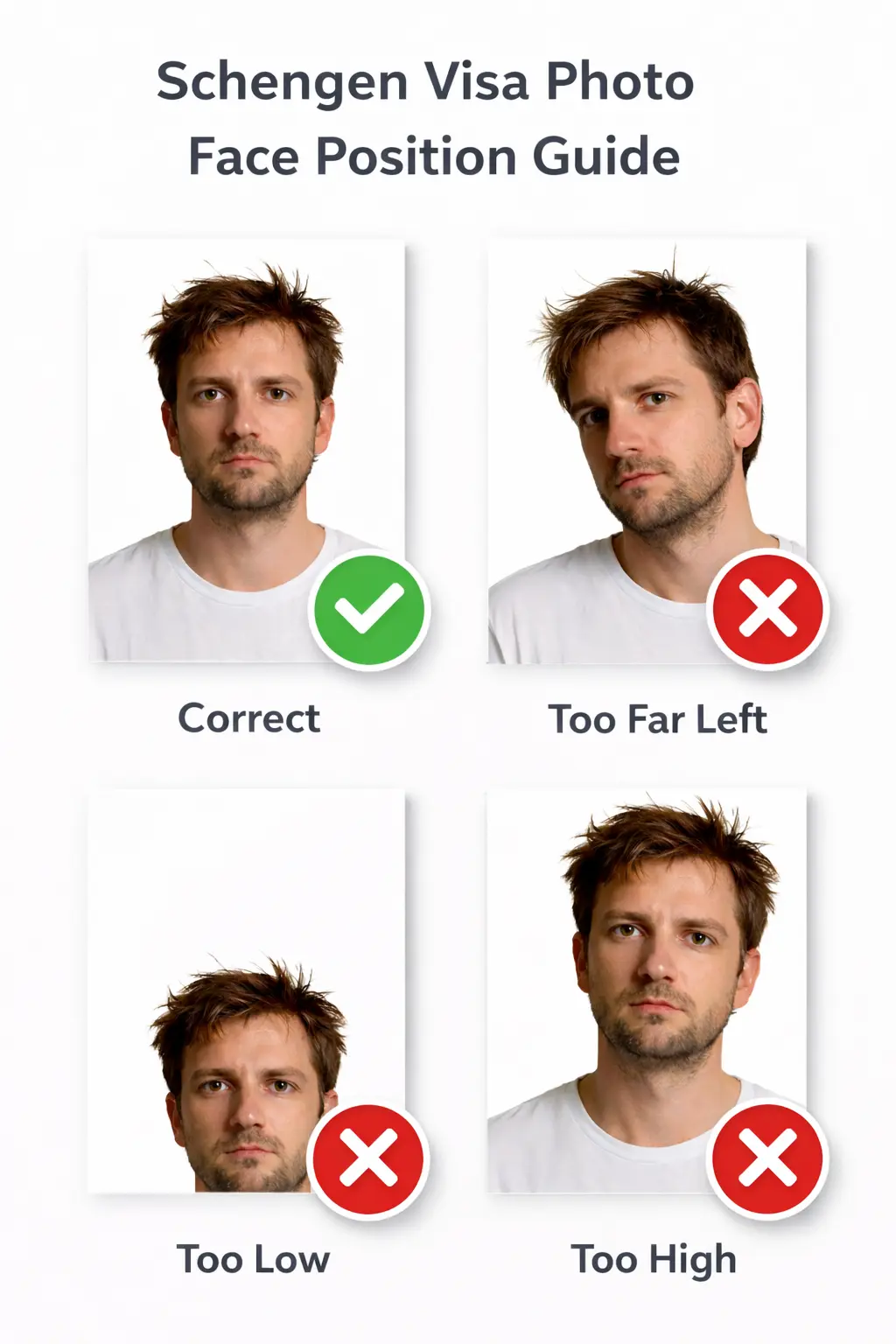
Biometric software checks face position automatically when you submit online. Meeting these Schengen visa photo specifications for face framing is essential:
- Position: Face directly forward, centered both horizontally and vertically
- Expression: Neutral — mouth closed, no smile, no raised eyebrows
- Eyes: Open, clearly visible, not obscured by hair, lashes, or glare
- Head tilt: Not permitted — must be perfectly straight
- Gaze: Looking directly at the camera lens
- Lighting: Even frontal illumination, no shadows across nose or chin, no red-eye
A good Schengen visa photo checker will automatically scan your image for these biometric parameters — flagging head tilt, closed eyes, or shadows before you submit, saving you from a costly rejection.
Dress Code and What Not to Wear
There is no formal dress code for a Schengen visa photo, but several items are specifically prohibited and others are strongly advised against.
Wear:
- Regular, everyday clothing in medium or dark tones
- Solid colors that contrast clearly against the white background
Do not wear:
- White or near-white tops (they blend into the background)
- Hats, caps, or beanies of any kind
- Sunglasses or prescription glasses — glasses are not permitted in Schengen photos as of 2015, per ICAO biometric standards
- Military, police, or other uniforms (except for official duty applications)
- Heavy accessories or large jewelry that distract from the face
Head coverings are allowed only for verified religious or medical reasons. If worn, the entire face must be fully visible — from hairline to chin, ear to ear — with no shadows cast on the face.
Schengen Visa Photo Sample: What Accepted vs. Rejected Looks Like
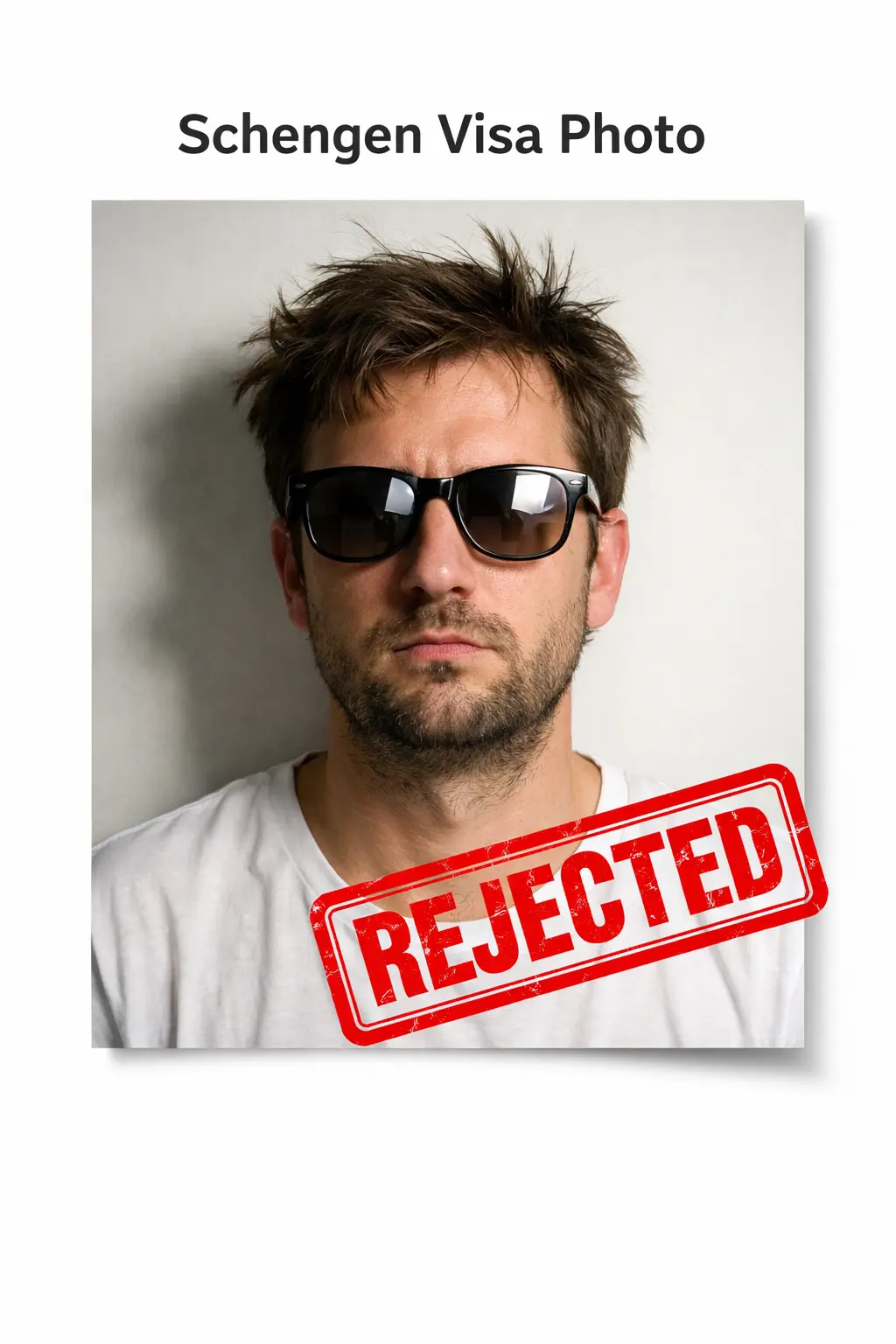
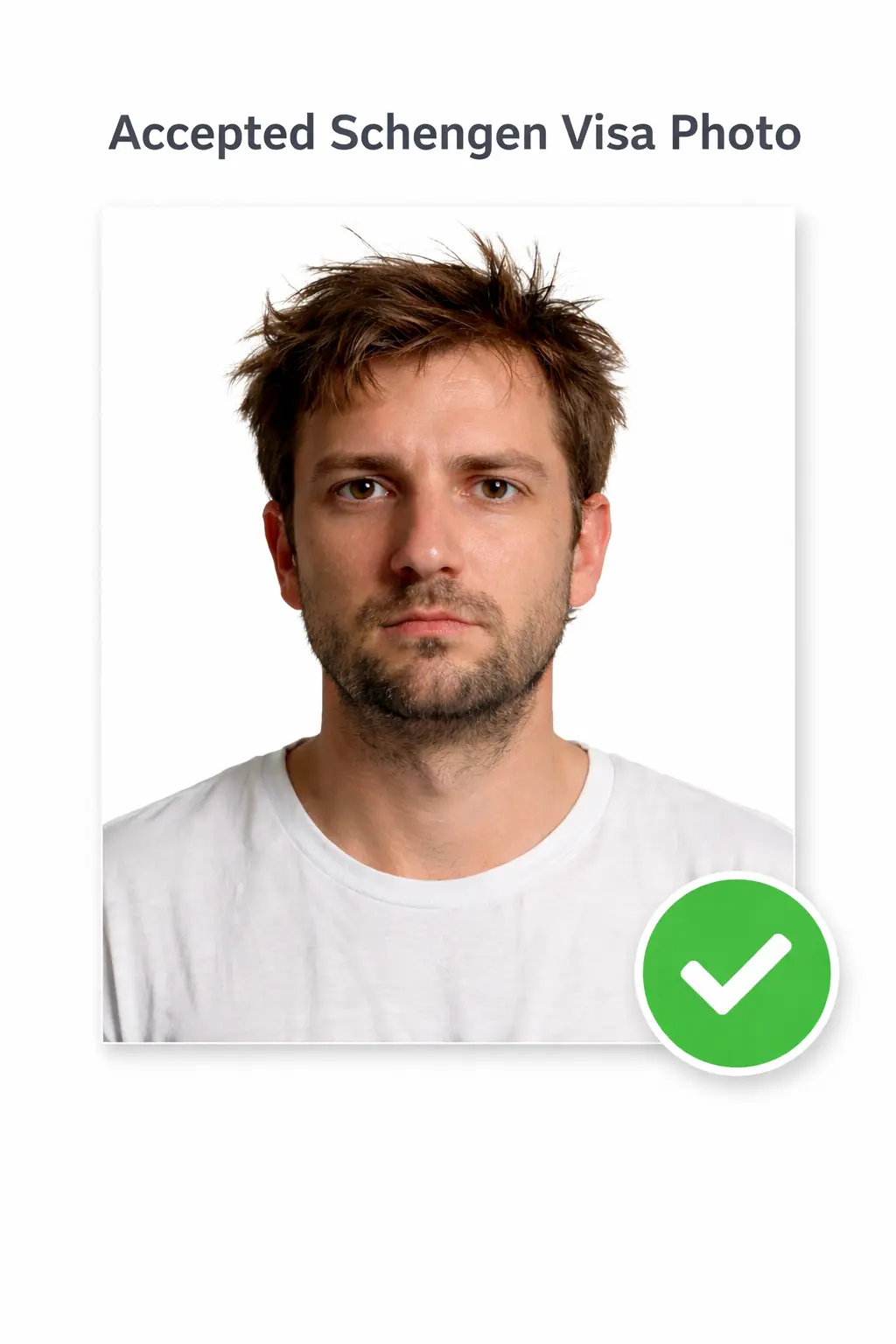
The most common reasons a Schengen visa photo gets rejected:
- Wrong dimensions — not 35×45mm or incorrect face ratio
- Colored, textured, or shadowed background
- Glasses (any type — prescription, reading, or fashion)
- Photo older than 6 months
- Smiling or open-mouth expression
- Blurry, low-resolution, or over-edited image
- Incorrect file format or oversized digital file
DIY Schengen Visa Photo: Take It at Home Step-by-Step
A Schengen visa photo DIY approach works perfectly well if you follow the process carefully. You don't need a professional Schengen visa photo studio near me search or an expensive high street appointment — a decent smartphone and the right online tool are all you need.
- Stand or sit against a plain white wall (or hang a white sheet as a backdrop)
- Position yourself at least 1 metre from the wall to avoid shadow
- Use soft natural light from a window directly in front of you, or a ring light
- Set your phone camera to eye level — not above or below your face
- Remove glasses, hats, and heavy jewelry before shooting
- Keep a neutral expression, mouth closed, eyes open and looking at the lens
- Take 5–10 shots and select the sharpest, most evenly lit one
- Upload to a Schengen visa photo online tool to crop, resize, and verify compliance
The last step is the most important — manual cropping to the exact 35×45mm spec with correct face positioning is difficult to do accurately in a standard photo editor. An AI-powered Schengen visa photo cropper handles this automatically and also runs a built-in compliance check before you download.
Free Schengen Visa Photo Maker Tool: The Fastest Way in 2026
The easiest, most reliable way to get a fully compliant Schengen visa photo online free is to use an AI-powered photo maker. These tools eliminate every manual step that typically causes errors.
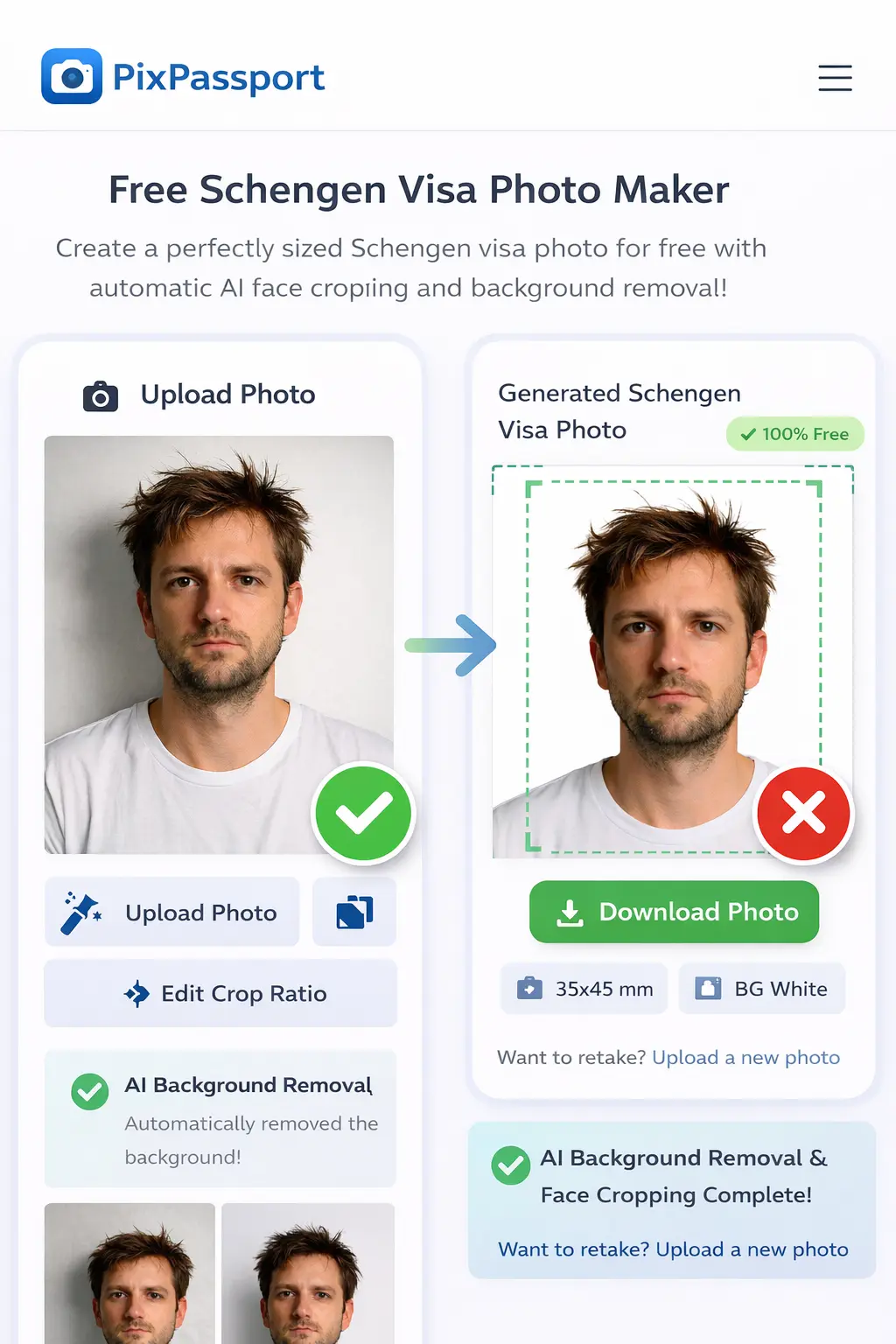
A good Schengen visa photo maker free tool — like PixPassport — does all of the following automatically:
- Background removal and replacement — detects and replaces any background with compliant white, even if you photographed yourself against a grey wall or in a room
- Smart face detection and cropping — positions your face at the exact correct ratio within the 35×45mm frame
- Built-in Schengen visa photo checker — scans for head tilt, eye visibility, expression, shadow, and lighting issues before you download
- Correct file output — exports at the right pixel dimensions, DPI, and file size for both digital submission and print
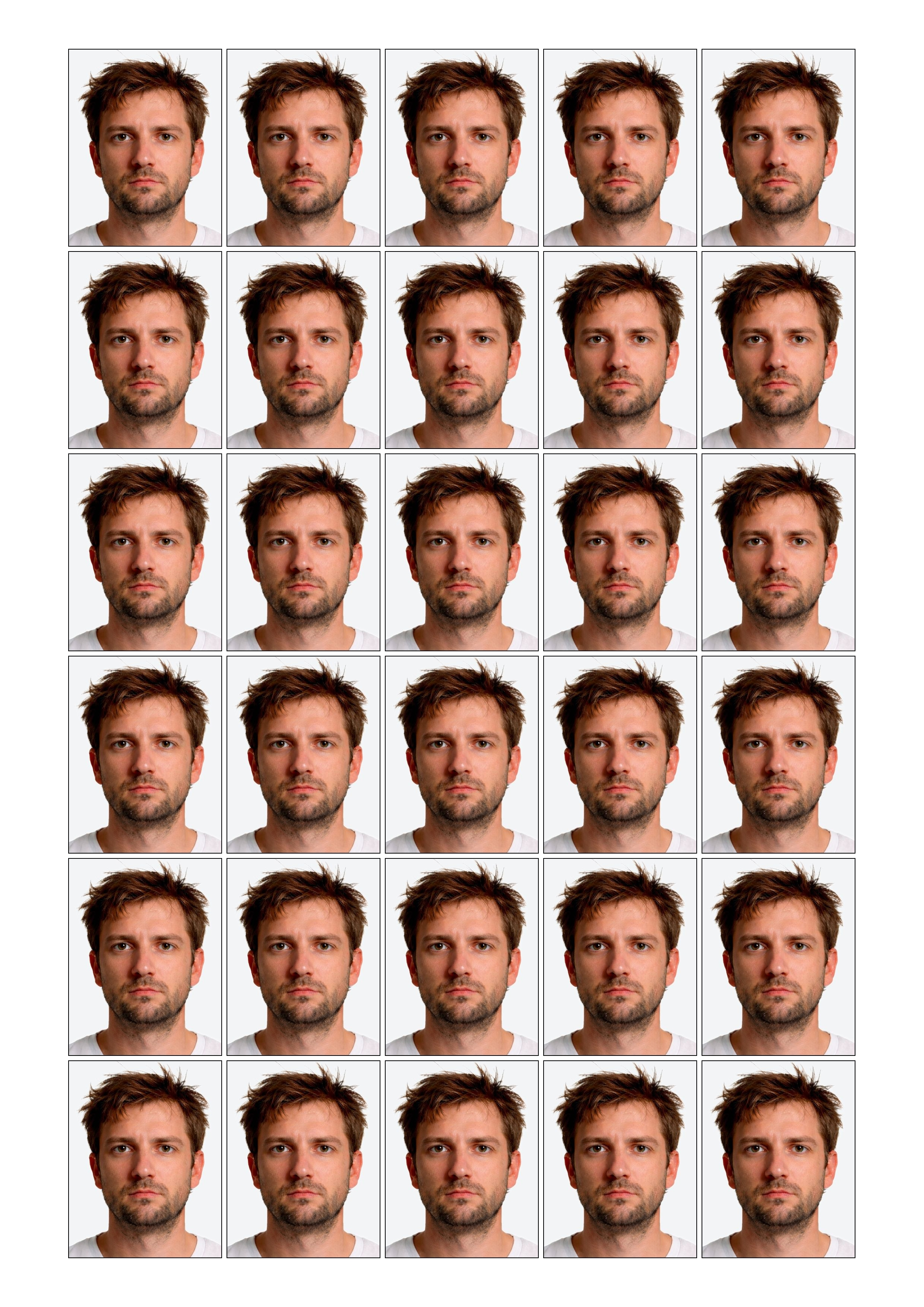
- Printable photo sheet — generates a sheet of 4 or 6 photos ready for physical embassy or consulate submission
The entire process — from selfie upload to downloadable compliant photo — takes under two minutes. No Schengen visa photo studio near me search required, no appointment, no travel, and no cost.
👉 Try the free Schengen visa photo maker now: Create Your Schengen Photo at PixPassport
Schengen Visa Photo for Babies and Children
Every applicant — including newborns — needs their own individual Schengen visa photo. The same 35×45mm size applies to children of all ages.
- No other person should appear in the frame (no parental hands or faces)
- Baby's eyes should be open if possible; closed eyes may be accepted at consulate discretion for very young infants
- White background is mandatory
- Full face must be clearly visible
Practical tip: Lay the baby on a white blanket and photograph from directly above. This naturally creates a white background, keeps the face centered, and avoids the shadow problem you get when trying to hold an infant upright. Upload to a Schengen visa photo editor free tool to crop and verify compliance.
Schengen Visa Application: What Else You'll Need
Beyond your photo, a standard Schengen visa application requires:
- Valid passport — valid for at least 3 months beyond your intended stay, with at least 2 blank pages
- Completed application form — varies by consulate; always download from the official embassy website
- Travel insurance — minimum €30,000 medical coverage, valid across the entire Schengen Area
- Proof of accommodation — hotel bookings, host invitation, or rental confirmation for the full stay
- Proof of sufficient funds — recent bank statements (usually 3–6 months)
- Round-trip flight itinerary — confirmed or provisional booking showing entry and exit
- Purpose of travel documentation — varies by category (tourism, business, family visit, study, etc.)
Fees and Processing Times
The standard Schengen visa fee in 2026 is €90 for adults and €45 for children aged 6–12. Children under 6 are exempt. Fees are non-refundable regardless of outcome.
Standard processing takes 15 calendar days, though this can extend to 30–45 days during peak travel periods (June–August, Christmas). Apply at least 6–8 weeks before your planned travel date. Many consulates require an in-person biometric appointment for fingerprinting — book this as early as possible, as slots fill up fast.
Top Tips for Photo and Application Approval
- Use a free Schengen visa photo tool — don't try to manually crop and resize. AI tools are faster and more accurate.
- Run a compliance check before submitting — a Schengen visa photo checker catches errors you may miss visually.
- Apply to the right consulate — submit to the consulate of your primary destination or first point of entry.
- Don't wait on insurance — travel insurance is required at application time, not just travel time.
- Be consistent across documents — travel dates, accommodation addresses, and financial information must align across every document submitted.
- Keep digital copies of everything — save PDFs of all submitted documents in case of follow-up requests.
Conclusion: Nail Your Schengen Visa Photo and Travel with Confidence
The Schengen visa photo requirements are precise — 35×45mm (3.5×4.5cm), white background, face filling 70–80% of the frame, no glasses, no shadow, neutral expression, taken within 6 months. Nail every one of these specifications and you remove one of the most common causes of visa rejection entirely.
Instead of searching for a Schengen visa photo near me or visiting a studio, use a free Schengen visa photo online tool to create a perfectly compliant image at home in minutes. It's faster, cheaper, and just as accepted by every consulate worldwide. For comprehensive Schengen visa application checklists and travel readiness guides beyond photo validation, tools like Visa Ready Now offer helpful step-by-step assistance.
👉 Get your compliant Schengen visa photo in 2 minutes — free: PixPassport – Free Schengen Visa Photo Maker
Avoid Passport & Visa Photo Rejections
Our automatic AI tool fixes background shadows, crops to exact millimeter specs (2x2" or 35x45mm), and guarantees 100% biometric compliance.
Create & Fix My Photo Now