Austrian Passport Photo Requirements 2026 (Reisepass Passbild)
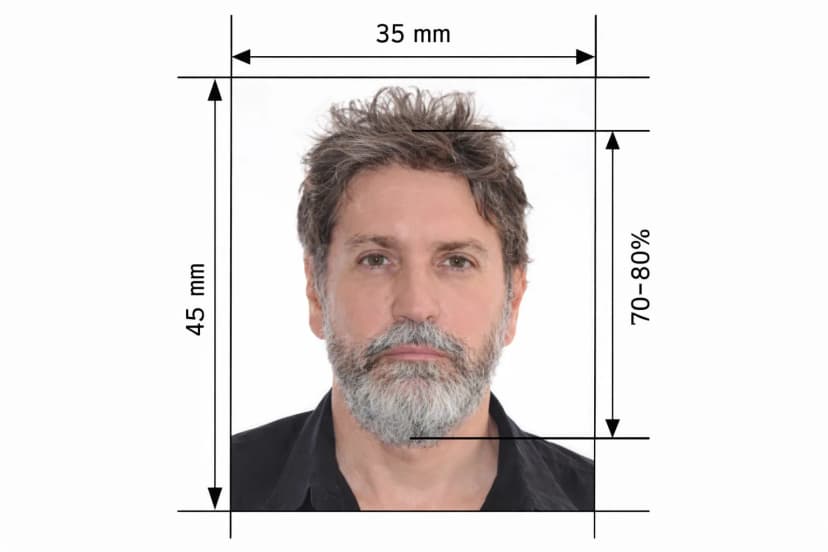
Austria, as a member of the Schengen Area, follows the biometric photo standards set by ICAO Doc 9303 and the EU framework for identity documents. The Austrian passport photo must be 35 × 45 mm in size and submitted in colour. According to the official criteria published by the Bundesministerium für Inneres (BMI) and Austrian representations abroad, the face must cover approximately two-thirds (2/3) of the photo, with the head height from chin to crown measuring between 32 mm and 36 mm. The eyes must be positioned in the upper half of the photograph, with a minimum distance of 8 mm between the centres of the two eyes. The head height must not exceed 36 mm.
Austria Passport Photo — Technical Specifications 2026
Face Size and Positioning: What the Official Criteria Require
The official Austrian Embassy photo criteria state that the face must cover approximately two-thirds of the photo area, with the chin-to-crown height between 32 mm and 36 mm. The head should not exceed 36 mm — a face that is too large in the frame is equally grounds for rejection as one that is too small. A minimum top margin of 3 mm between the crown of the head and the top edge of the photo is required. Both eyes must be clearly open, looking directly at the camera, and positioned in the upper half of the photo. The minimum inter-eye distance (measured between the centres of the two eyes) is 8 mm, as specified in the BMEIA's official passport photograph criteria.
Austrian passports are manufactured centrally at the Österreichische Staatsdruckerei (OeSD) in Vienna. Because the biometric data page stores a high-resolution facial image, submitting a photo where the face is properly sized — within the 32–36 mm range — ensures that the printed image on the polycarbonate data page remains sharp and readable at automated border control e-gates throughout the Schengen Area.
Austrian Passport Photo Checklist (Passbild-Kriterien)
- Recency: The photo must not be older than 6 months, as confirmed by the BMEIA. It must represent your current appearance.
- Facial Expression (Neutraler Gesichtsausdruck): A neutral expression is required. The mouth must be closed. Eyes must be open and looking directly at the camera.
- Background: The background must be light and plain — white or light grey is standard. There must be no shadows, patterns, or objects in the background.
- Lighting: Even illumination across the face is required. Shadows behind the head or on the face are grounds for rejection. There must be no reflections or glare.
- Hair: Hair must not cover any part of the face.
- Glasses: Glasses are permitted only if the eyes are fully visible and there are no reflections on the lenses. Tinted lenses and sunglasses are not allowed.
- Head Coverings: Not permitted unless required for religious or documented medical reasons.
- Clothing: Everyday clothing is acceptable. Avoid white, grey, or beige tops that may blend into the light background. Uniforms are not permitted.
In-Person Application — No Postal or Online Exceptions
As confirmed by the BMEIA, all Austrian passport applicants must appear in person without exception — including minor children. Applications cannot be submitted by mail or processed online. A prior appointment at the competent passport authority (Magistrat or Bezirkshauptmannschaft) is required. Processing takes up to five weeks, as biometric passports are produced centrally in Austria.
ID Austria and Digital Identity Services
Austria's ID Austria — the digital identity system and successor to the Handy-Signatur — allows citizens to access hundreds of government portals, from tax filings to municipal services. Activating or upgrading ID Austria requires an in-person appointment at a passport authority, and applicants must bring a current passport photo and a valid identity document, as confirmed by the BMEIA. ID Austria does not replace the in-person passport application process; it is a separate digital identity credential used for online government service authentication.