France Visa Photo Maker: Size, Requirements & Online Editor (35×45 mm)
Applying for a short-stay Schengen visa (Type C) or a long-stay national visa (Type D)? This online France visa photo tool turns one selfie into a picture that meets the 35×45 mm standard. It crops, resizes, replaces the background, and checks your photo against ICAO rules. Then it gives you a digital file and a print sheet. Read on for the exact specifications and the mistakes to avoid.
What This Tool Delivers
Make Your France Visa Photo Online in 3 Steps
The editor handles the technical work. You only supply a good selfie, so you can make a photo for a French visa online without visiting a studio.
1. Upload Your Photo
Take a photo with your phone against any indoor wall. Face the light, look straight at the lens, and keep a neutral expression. Remove your glasses and tie back hair that covers your eyes. Upload the image to the editor.
Stand about one meter from the wall, and place a lamp or window in front of you. Ask a friend to take the picture at eye level for the best result.
2. Auto-Crop, Background & ICAO Check
The tool detects your face and applies every fix in seconds:
- Auto-crop: Frames your head to the 35×45 mm ratio and removes any tilt.
- Background: Replaces it with a plain, light, shadow-free tone.
- Head scale: Sets your head to 70–80% of the frame.
- ICAO check: Flags smiles, glasses, glare, and heavy shadows so you can retake the shot.
3. Download Digital File or Print Sheet
Preview the result for free, then pay once to download the HD files. You receive a 413 × 531 px JPEG for online upload and a print-ready sheet for your appointment. Reprocess as often as you like, so you never pay twice for a rejected attempt.
France Visa Photo Size & Requirements (2026)
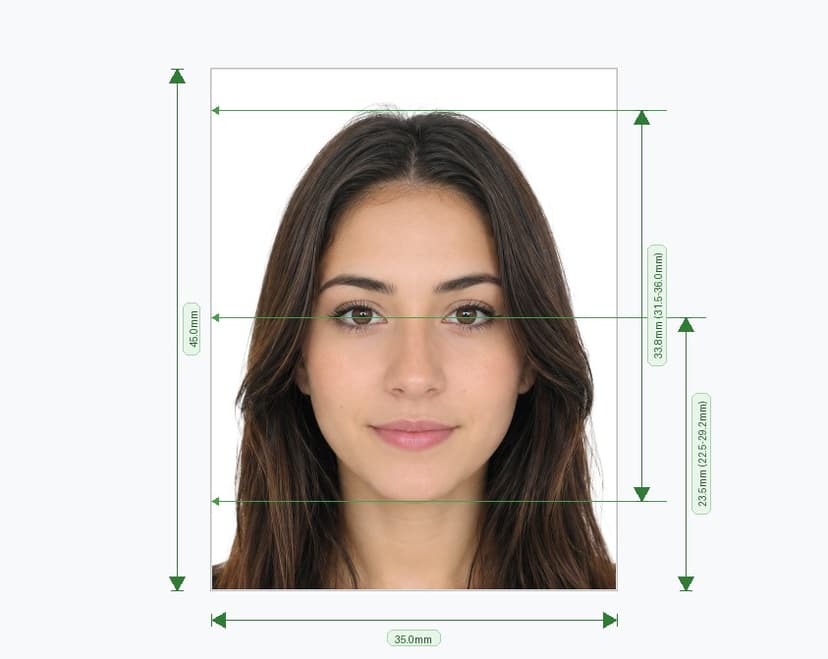
The France visa photo size follows the international biometric standard. Check these France visa photo requirements before you apply, because consulates reject photos that miss them.
France Visa Photo Dimensions & Resolution (35×45 mm)
The visa photo size for France is the same for Schengen and national visas:
- Print size: 35 mm wide × 45 mm tall.
- Digital size: 413 × 531 px at 300 DPI.
- Face height: 32–36 mm from chin to crown, which equals 70–80% of the photo.
- Position: Center your face and look straight at the camera.
- Age: Take the photo within the last six months.
France Visa Photo Background Color, Lighting & Expression
The correct France visa photo background color is plain light, such as light grey or off-white. These France visa photo guidelines cover everything else you control:
File Format & File Size for Online Upload
Export the photo as a JPEG at exactly 413 × 531 px. A wrong pixel size forces the portal to stretch or squeeze your image, which pushes your head outside the accepted range. Portals also set a maximum file size, so check the limit on your upload screen. The editor keeps the file compact while preserving sharp facial detail.
France Schengen Visa Photo Requirements for VFS & Embassy
The France Schengen visa photo requirements and the Schengen visa photo size stay the same wherever you apply, but the submission method changes. You may apply through the France-Visas portal, a VFS Global center, or a consulate.
VFS France Photo Specification
VFS centers accept the standard 35×45 mm biometric photo. Staff check the size, background, head height, and expression. Some centers also take your photo on site, but a compliant photo saves time and money. Always confirm local rules on your center's page.
The photo specification for a France visa can vary slightly by country and by center, so read the checklist that comes with your appointment confirmation. When a center's rule differs from this guide, follow the center's rule.
France Embassy Photo Size: Printed vs Digital
The France embassy photo size is also 35×45 mm. Prepare both versions:
- Digital photo: Upload the 413 × 531 px JPEG when the France-Visas form asks for it.
- Printed photo: Bring a 35×45 mm print on matte, high-quality paper. Do not trim it by hand or glue it crooked.
Bring both versions to your appointment. If staff request a fresh print, you have it ready.
Tourist, Student & Other Visa Types
The France visa application photo size does not change by category. Tourist, business, student, family, and work visas all use the same standard. Type C and Type D applicants follow identical rules, so one compliant file works for every category.
Tip: if you also need a passport photo, create both from the same selfie. The France visa passport photo size and the passport size match, so you save time and avoid retakes.
ICAO Standards Explained for France Visa Photos
ICAO (the International Civil Aviation Organization) sets the biometric photo rules that France applies. Border systems store your photo in the Visa Information System (VIS) and compare it with your face at every Schengen crossing.
These checks matter because France compares your live image with the stored photo at automated border gates. A clean, standard photo reduces the chance of a manual inspection and speeds up your arrival.
The editor's ICAO check tests these points before you download, so you catch problems early.
France Visa Photo Examples: Accepted vs Rejected
Accepted Photo Example
An accepted France visa picture shows a centered face that fills 70–80% of the frame. The person looks straight ahead with a closed mouth and open eyes. Soft, even light falls on the face, and a plain light background sits behind the head. No glasses, glare, or shadows appear.
Top Rejection Reasons & How to Fix Them
Before you submit, run this quick final check: your face fills the frame, your eyes are visible, your mouth is closed, the background is light and plain, and the file is a 413 × 531 px JPEG. If every point passes, your photo is ready.
Protect Your Appointment Slot
A photo rejection can cost you an appointment and add weeks of delay. Fix the photo first, then submit with confidence. Preview free, and pay only when the result looks right.
Photo Visa France : Norme et Format (FR)
Pour votre photo visa France ou votre foto visa France, respectez la norme biométrique internationale. Le format officiel est de 35 × 45 mm, soit 413 × 531 pixels en version numérique.
- Visage : centré, de face, avec une hauteur de tête de 32 à 36 mm (70 à 80 % de la photo).
- Fond : uni, clair et sans ombre.
- Expression : neutre, bouche fermée, yeux ouverts.
- Lunettes : interdites, même avec un traitement antireflet.
- Date : photo de moins de six mois.
- Format : JPEG pour le dépôt en ligne, tirage mat pour le rendez-vous.
Importez votre selfie, vérifiez l'aperçu gratuit, puis téléchargez votre fichier conforme. L'éditeur recadre la photo, remplace le fond et contrôle les critères ICAO en quelques secondes.
FAQs
What is the France visa photo size? 35×45 mm, or 413 × 531 px at 300 DPI for the digital JPEG, with your head at 70–80% of the frame.
What background color does a France visa photo need? A plain, light, shadow-free background. The tool sets it automatically.
Can I make a France visa photo online? Yes. Upload a selfie, review the free preview, and download the HD file and print sheet once the ICAO check passes.
Is the Schengen visa photo size the same as the France visa photo size? Yes. France follows the 35×45 mm Schengen biometric standard.